FORTY-FOUR YEARS after the declaration of Martial Law, various student leaders have expressed their support for a joint resolution declaring every September as a month of “national truth-telling, reflection, and reconciliation.”
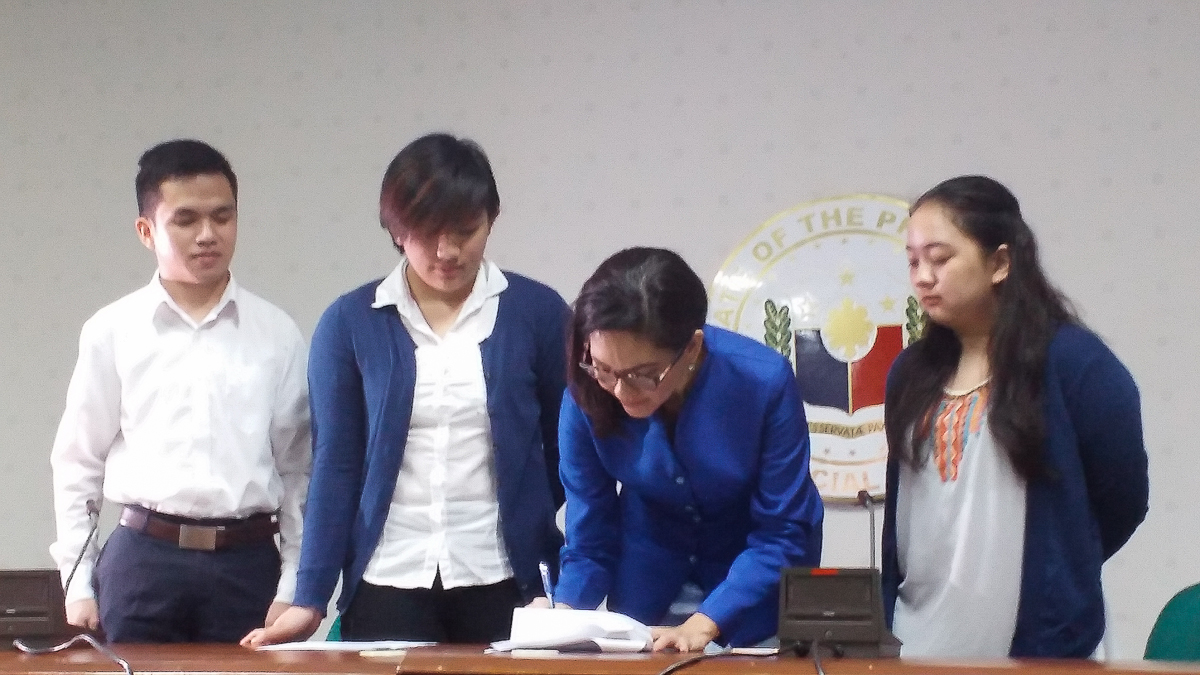
Joint Resolution No. 4 was filed by Sen. Risa Hontiveros in the Senate while Akbayan Rep. Tom Villarin authored its counterpart in the House of Representatives.
According to Hontiveros, the resolution urges all schools to hold month-long educational activities on Martial Law to further educate the youth on “democratic values and practices” that the nation experiences at present.
Representatives from Adamson University (AdU), Ateneo de Manila University (ADMU), and University of the Philippines-Manila (UPM) were present at the Senate yesterday to support the initiative.
Reflecting on history
AdU Student Government President John Joshua Mayuga agreed that there is a need to recall what had transpired during the Marcos regime.
He shared that he is often criticized for “focusing too much on the past” when he promotes consciousness on Martial Law. However, he said that it becomes even more important to talk about the past because the same problems still linger today such as enforced disappearances, extrajudicial killings, and systemic corruption.
“Truth can do many things–it builds and it destabilizes,” Mayuga said. “We need to build another generation of heroes who will rise up again like what our forerunners, former student leaders, did during the Marcos regime.”
“The more that we experience these problems that confronted us during Martial Law or during the time of late President Ferdinand Marcos, the more that it necessitates for us to look back in our history and to reflect,” he added.
Meanwhile, ADMU Sanggunian Deputy for Advocacy Management Karin Bangsoy said that the past, present, and future are all in play in this resolution.
“The youth today are products of the past,” Bangsoy said. “Even if we have not experienced for ourselves what had happened during Martial Law–all the atrocities, all the stories, all the experiences–we are the product of that specific point in time,” she added.
Saying that the youth are the hope of the future, Bangsoy said that there can be no moving forward, if there is no acknowledgement of the past.
“We believe that it is important for the youth–in the provinces, in Metro Manila, and the indigenous youth–to remember and be educated on what really happened during that point in time in our history,” she said.
“With that, we support this resolution,” Bangsoy added.
Institutionalizing knowledge
Hontiveros said that the proposal for a “national truth-telling” month is consistent with the provisions of Republic Act (R.A.) No. 10368 or the Human Rights Victims Reparation and Recognition Act of 2013. This law authorizes the government to implement the mandatory teaching of Martial Law history at all levels.
However, she lamented that the government’s educational institutions have not yet included the teaching of Martial Law history in the basic, secondary, and tertiary levels, three years after the passage of the law.
“I call onto the Duterte administration to implement the mandatory teaching of Martial Law history as provided for by R.A. No. 10368,” Hontiveros said.
According to her, the Philippines can learn from the experience of Germany and other countries ravaged by Adolf Hitler during World War II that “took it upon themselves to enforce the institutional teaching of Nazism’s horrific past in order to memorialize and honor the victims.”
Opposing the burial
Hontiveros also renewed her opposition to the proposed burial of Marcos at the Libingan ng mga Bayani, calling on the Duterte administration “to abandon” the plan. She deemed the move as the “ultimate act of airbrushing history in favor of the Marcoses.”
“Naniniwala ako sa pagpapatawad sa kapwa pero ‘yung totoong reconciliation ay kambal din ng hustisya. So bago pa ‘yung pagpapatawad, importante na makumpleto ‘yung sinasabi kong three As: acknowledgement, apology, and amends,” she said.
(“I believe in the essence of forgiving other people, but genuine reconciliation comes with justice. Before forgiveness, it is important to complete the three As: acknowledgement, apology, and amends,” Hontiveros added.)
“Huwag natin hayaan na pagnakawan tayong muli ng mga Marcoses. Huwag natin payagan na nakawin nila ang ating kasaysayan at katotohanan (Never let the Marcoses steal from us again. Never let the Marcoses steal our history and the truth),” Hontiveros added.