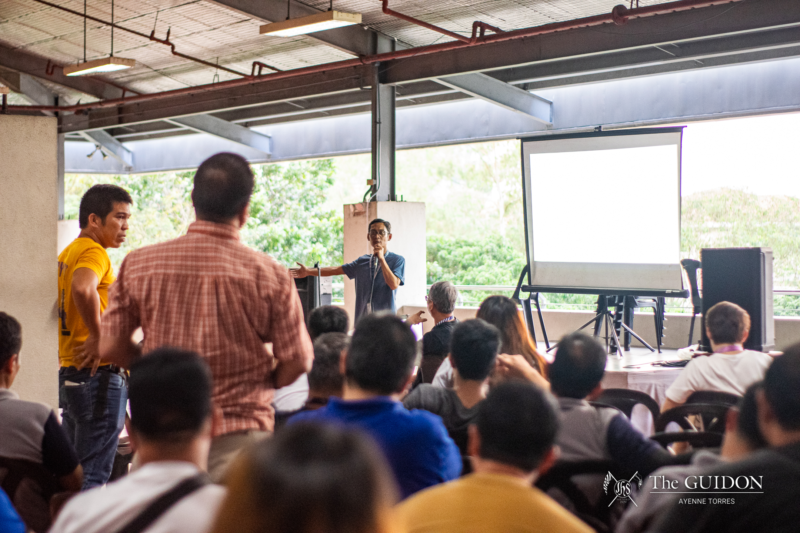
Nebres and 120 other academic leaders from various universities—both local and foreign—gathered in the Presidents’ Forum, held January 22 to 24 at Escaler Hall.
Entitled “Universities at the Frontiers of Change,” the event aimed to highlight the challenges of universities in a more global and multicultural world.
In light of the financial crisis, Nebres said Ateneo’s primary objectives are closing the poverty and competitiveness gap, and forming leaders for the common good.
Aside from Nebres, four other academic leaders delivered presentations. They are Ng Ching Fai of Hong Kong Baptist University, Shin-ichi Ago of Kyushu University, Jean-Philippe Ammeux of Lille Catholic University, and John DeGioia of Georgetown University.
The poverty problem
Nebres wants the Ateneo to be at pace with its East and Southeast Asian neighbors, and to close the gap between the rich minority and the poor majority.
The Ateneo has been active in helping the poor through empowerment, he said. He gave as an example Ateneo’s tie-up with Gawad Kalinga, as well as the University’s engagement with the local government in Payatas to give quality education to one of its public elementary schools.
Nebres also said that university traditions are not enough for change to occur. “We must go beyond the traditional roles in the university in order to create change in society.”
Nebres said the Ateneo can realize these ideals by focusing on leadership formation, which includes leadership in orgs, and forming professionals for others.
“The problem of professionals is that they control and protect their world even if the greater good says something else,” he said.
National development: challenges
National development must be interdisciplinary; it needs the help of every sector, said Nebres. “No single discipline can solve [poverty].”
He explained how other Ateneo schools help with the goal of national development.
The Ateneo School of Government emphasizes local governance through the delivery of basic services to the poor. The Ateneo School of Medicine and Public Health balances clinical training and management of health care.
Ateneo Law School, meanwhile, goes beyond preparing the students for the bar exams through participating in research relevant to the country. The Ateneo School of Business challenges students to build businesses not just for profit, but also for nation-building.
History Associate Professor Stephen Henry Totanes, Ph.D, one of the faculty members present during the forum, agreed with Nebres. He said education should be more universal.
“The more we interact with other universities … [the] more beneficial for us to get into action,” said Totanes.
Help from the community
On public education, Nebres also said it is still possible to improve public schools in the country. The challenge is how to institutionalize it into a university.
Nebres also discussed the challenge of fusing academic excellence and social responsibility, and the challenge of coming up with relevant research.
Despite the unchanging social landscape of the Philippines, he still hopes that there will be change. “The problems are challenging, but [it] can be solved,” Nebres said.
He said that solving the poverty problem should involve not just an individual or a group, but the whole community. “In order to make this difference…you have to engage society.”