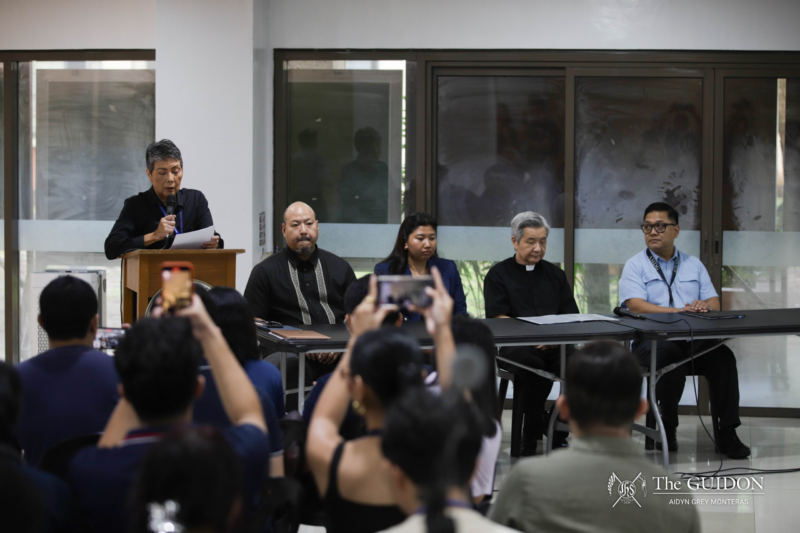
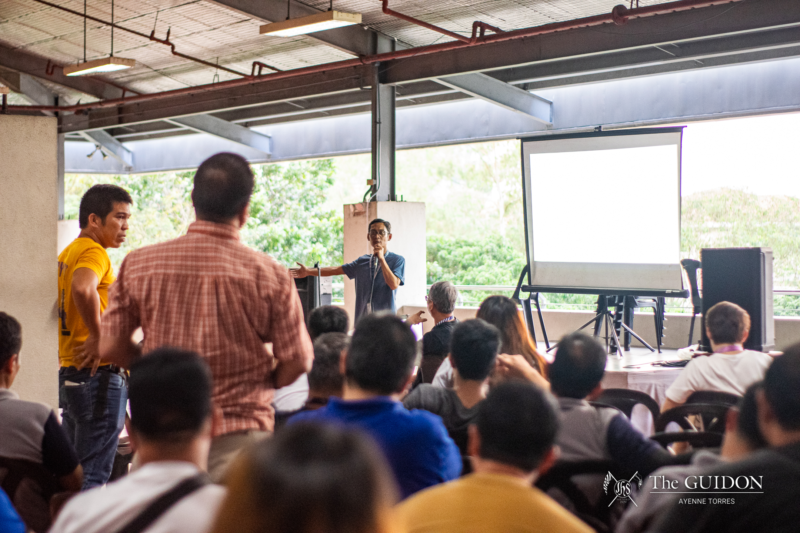
In a talk dubbed the State of the Urban Poor Address (SOUPA), Malayang Tinig ng mga Kababaihan sa Komunidad President Rosal Palma told stories of the urban poor in their settlements—mothers who died during labor because of unethical and improper procedures, of children who died because of hunger and poverty, and the lack of medicine and doctors in urban poor barangays.
Palma interacts closely with the urban poor, and is one of the three speakers in the talk that also discussed the urban poor’s situation and importance in society.
The other two speakers were Institute on Church and Social Issues Executive Director Anna Marie Karaos Ph.D., and University of the Philippines-Manila College of Medicine Associate Professor Dr. Portia Fernandez-Marcelo.
The talk, organized by the Ateneo Student Catholic Action (ATSCA) was held December 18 at the Leong Hall Auditorium.
Urban poor as “most important”
The urban poor are the most important people in society, Karaos said. “We cannot live the way we are living, at least not comfortably, if not for the laborers,” she said. Karaos, who discussed the basics of urban poverty, added that the urban poor were not only informal settlers but also the working class.
Dr. Marcelo discussed the RH Bill and other health issues the urban poor are facing, and gave examples of situations where the RH Bill is not implemented.
Palma narrated experiences and situations occurring in urban poor settlements. “Mahirap ang karanasan ng mga maralitang taga-lungsod (The experience of the urban poor is difficult).” “Merong doctor sa health center kaso lang pinaghahatian siya ng mahigit sa 30 barangay (There’s a doctor in the health center but more than 30 barangays go to him),” Palma said.
A face to the statistic
Carlos Joseph Frederick Mangco (IV AB PoS), SOUPA’s project head, said that ATSCA stressed the need for dialogue regarding these issues during the talk.
“They did not explicitly say, ‘you should do this,’ but I guess that by presenting this information, they are actually giving us a way of addressing these concerns,” Carmina Reyes (III AB Comm) said.
“The problem of the poor cannot be encapsulated by a simple yes or no in the RH bill,” Mangco said. There is a need to reach further down to the people affected by these issues because they are not that knowledgeable about it, he added.
“Kasi (Because) the academe is teaching from the high, you cannot really explain that to the poor so dapat nasa (it’s supposed to be) low level,” Mangco said. Eduardo Anthony Mariño (III AB Eco), who attended the talk, said he appreciated that one of the speakers, Palma, brought a face to poverty.
“They don’t simply want to reach us with the statistics, they would want to reach us with their stories,” said participant Camille Nathalia Martinez (II AB Lit Eng).