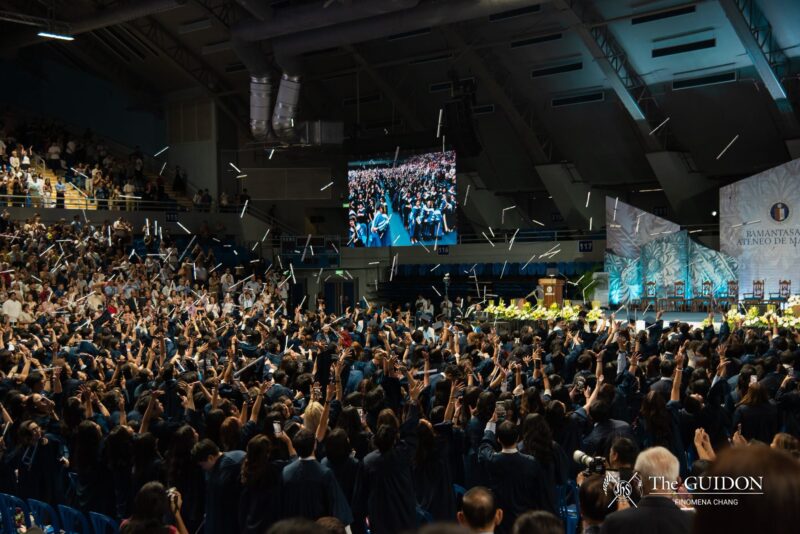
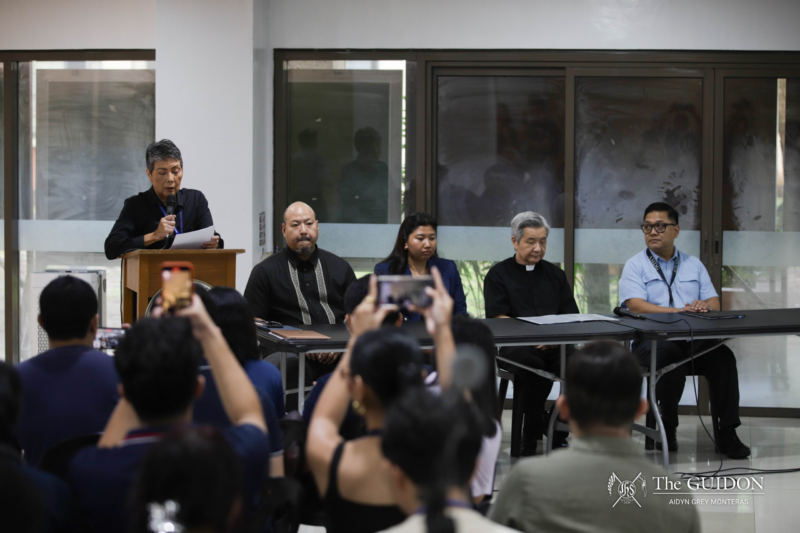
In a celebration for United Nations Day, 24 students —each hailing from a different Asian country— graduated from the University of Peace (UPeace) in the Ateneo.
On October 24 at the Leong Hall Auditorium, the students wrapped up their International Peace Studies courses in the Ateneo, and in Costa Rica. They had been peace studies students since April 2007. Their graduation was a first for Asian countries affiliated with UPeace.
The students carry with them the belief that they “are trees planted by the hands working for peace,” says student Menandro Abanes, in his batch’s farewell message.
Abanes, a Filipino, was one of the few selected Asians granted a scholarship by Japan’s Nippon Foundation and took International Peace Studies in the Ateneo and Costa Rica, where the other UPeace campus is located. In the Ateneo, the Political Science Department hosts the program, established in 2007.
The campus in Costa Rica, which is a “small university…[but] a giant in conflict studies,” says Abanes, has been around for decades, like peace studies, which begun as a field of studies in the 1950s, under the threat of nuclear combat in the Cold War.
A higher peace education
Established in Costa Rica in 1980, UPeace is the only university mandated by the United Nations to provide Master and Doctoral degrees in International Peace Studies.
The program in the Ateneo started because of “the need to bring in more Asians into the International Peace Studies Program, especially Asians who are coming from countries where English is not the most widely-spoken language,” says UPeace Project Head Fermin Manalo.
The students in the Ateneo’s Dual Program will take up English courses. They will then fly to the UPeace headquarters in Costa Rica to take up peace-related courses.
By March, the students will return to Ateneo to take up more peace-related courses. They will also take up internships in international organizations, non-government organizations (NGOs), aid agencies, and the like, before graduating in October.
Course syllabus
UPeace students develop multiculturalism because of their exposure to two different countries. They also develop a cosmopolitan view of themselves, that they are part of the world, says Balazs Kovacs, MD, an instructor in the Peace and Conflict Studies Department of UPeace.
“They’re not just Filipinos—they also belong to a broader community. They’re not just Bangladeshi—they belong to a broader community. And so on,” he says.
Aside from developing a wider worldview, UPeace students also take up courses like Conflict Prevention, Asian Peace Psychology, and Small Arms, Arms Control, and Human Security in Asia. These courses, says Kovacs, aim to “dismantle the idea that violence is the solution to your problem,” he says.
“It’s not about the elimination of conflict—it’s about how to deal with your conflict,” he adds.
Students studying peace may also find that the subject is encompassing, and that job opportunities after graduation are plenty.
“It’s a question of what their priorities are,” said Manalo. “Peace is now being viewed in relation to development, human security, so you might want to purse a course on development, on policy advocacy, a course on gender and peace, or natural resources and peace, peace education, international diplomacy,” he says. There are also opportunities to work in direct conflict areas, either as peace-keepers or conflict rehabilitators, and even with children.
Manalo adds that although there are many professions devoted to peace-building, “The most important is being aware of how your program or your career can lead to developing a just and lasting peaceful environment.”
Seeing the world
Heung-soon Yeon, a Korean UPeace student, shares that she and her fellow students stayed in one house during their trip to Costa Rica. “Every day we cook together and we share each other’s stories. We’re like a family,” she says.
Aside from taking peace-related courses in Costa Rica and the Philippines, the students get to participate in each country’s current events.
“While we were in Costa Rica, some of us volunteered as international observers in its Referendum for Free Trade Agreement in the US,” Abanes says. “We also saw the elections in the Philippines.”
Yeon said what she loved about the program was meeting different people and getting to know their stories. “It’s good to share your culture with people from different countries.”
Abanes adds, “It’s not just about attending classes and learning the subject, but also learning from [others’] perspectives.”
According to Abanes, the world became small through UPeace. “That’s what UPeace did—to see that the world has people, and they have a face,” he says.
Working for peace
Yeon is planning to do research in South Korea. She also wants to learn about other countries’ education. “I want to teach peace education too. I want to do something to help my country,” she says.
Abanes, meanwhile, will be working in an NGO, to contribute to his “understanding of others.”
As his class bid farewell to UPeace in their graduation, Abanes says that he is confident his education will find its way to his vision of peace-building, adding that peace is not always about the opposite of conflict, but a way to live.