

Photo by Ean L. Dacay
Editor’s Note: In light of the renewed debate on campus about what politicization in the context of the university really means, The GUIDON is presenting a short historiography on this very matter. This work documents the major developments in campus politics since the rebirth of the collegiate political party system with Partido Agila’s founding in 2003, and contextualizes these recent developments within the greater history of Ateneo student politics. This is the second of three parts; the first part is available in the March – April 2011 issue of The GUIDON.
Part 3: Breaking the stalemate
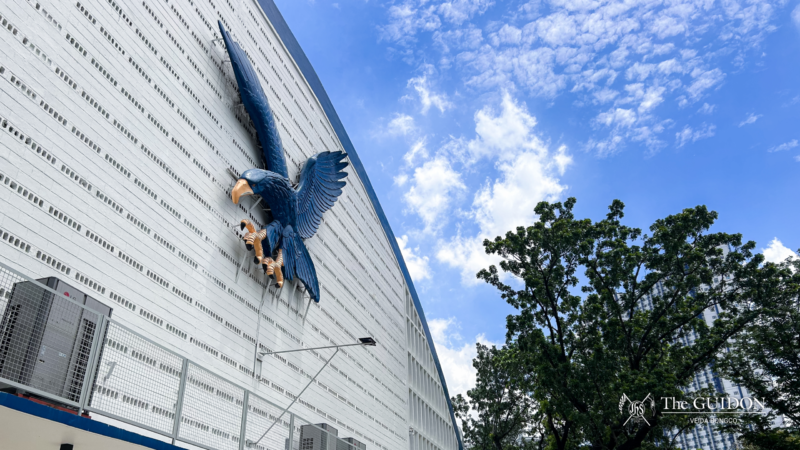
It was perhaps not the most pleasant sight for diehard Ateneans, especially the elder ones who treated all Atenean insignia with the utmost veneration. It would have been all too weird for them: seeing two age-old symbols of the Ateneo—the Blue Eagle and St. Ignatius of Loyola—set against each other in an electoral contest between students.
But such was the nature of Ateneo student politics when the scene was dominated by IsaBuhay IsaGawa – Agila (IBIG-Agila) and Partido Ignacio—just like the symbols behind which their members rallied, there seemed to be no substantial difference between what the two parties stood for: different in form, different in campaign paraphernalia, but ultimately offering the same thing.
Well, at least that was the criticism that came from the loudest quarters—independent student critics, The Assembly, and a supposed secret society that suddenly found much attention online, The Gadfly Society.
‘The Sanggunian is obsolete’
The very first post in The Gadfly Society’s Blogspot account is dated July 16, 2007. Little did those behind the Society know, though, that the coming months would prove critical for their organization—their eventual posts would generate such buzz and discussion in the community, as evidenced by the comments in their blog and the wide circulation of their emails.
Eventually, the Society gained even greater attention from the community when it was spotlighted in the banner article of The GUIDON’s November 2007 issue.
In the said issue, The Gadfly Society’s criticisms of the Sanggunian were presented to the entire community. And the Society didn’t hold back—their words were unabashed, unashamed and unapologetic in its harshness.
In one piece posted in its blog during November 2007, The Gadfly Society called out the Sanggunian for “crippled leadership,” alleging that the student government “has done nothing substantial or worthy of praise, except [for their actions regarding] the ‘Dress Code Buzz’ if you call that note-worthy.” At that time, there was a heated debate on campus regarding the proposed mandatory Loyola Schools (LS)-wide dress code.
A few months before, on the other hand, The Gadfly Society dared declare outright: “The Sanggunian is obsolete.”
The Society challenged the Sanggunian to do three things: to “tackle relevant issues that would directly affect the students such as tuition fee increases,” to “let the students know about [the services the Sanggunian offers],” and for the Sanggunian President to “hold an event that is similar to the [State of the Nation Address].”
While quite utilitarian in these demands, the Society seemed to have driven a point home as a result—that even in the most basic of basics, the Sanggunian fails to deliver.
And this was quite the rebuke for both IBIG-Agila and Partido Ignacio, since they practically dominated the entire Sanggunian during that time.
Controversies and resignations
As if the entire Sanggunian wasn’t agitated enough, what with all the criticisms and attacks hurled by The Gadfly Society, The Assembly, Matanglawin and even The GUIDON in its Opinion pages, one can safely say that the student government really hit rock bottom during the 2007-2008 school year.
It was rocked by the resignations of top student officials, and possibly the last straw was the revelation that the Sanggunian President at that time, Karl Satinitigan of IBIG-Agila, was not even enrolled for the second semester of his yearlong term—a fact that he didn’t disclose to anyone for an extended period of time.
He owned up to this fault, and admitted that he didn’t inform any of his colleagues, in a statement published in The GUIDON—but this wasn’t until a few weeks before his term was supposed to end. The Sanggunian Vice President, Cabrei Cabrera of Partido Ignacio, then assumed the top position even with just twenty or so days left in Satinitigan’s vacated term.
There hasn’t been any formal study of the matter that would connect all the dots, but it is interesting to note that after all this hullabaloo, IBIG-Agila and Partido Ignacio both lost in the elections, marking the first electoral loss of Partido Agila/IBIG-Agila in three years. An independent, Omi Castañar, won the presidency with an overwhelming 56.6% of the vote, compared to 21.9% for IBIG-Agila’s standard-bearer and 15.8% for Partido Ignacio’s standard-bearer.
The rebuilding process
Castañar’s term was relatively less noisy compared to the year before—there were less loud protests, less online bashing, and The Gadfly Society even seemed to quiet down.
It was the school year, after all, that the Ateneo opened itself to so many farmer groups—the Sumilao, Calatagan and Banasi farmers—so the Sanggunian found a lot of work to concern itself with.
While the Sanggunian’s visible efforts to help out the different farmer groups won it praise and recognition, it was another chain of events under the Castañar administration that would leave a more lasting impact on the state of student politics—or at least, on the state of student political parties.
No parties
On January 21, 2009, representatives from five different entities—IBIG-Agila, Partido Ignacio, the Ateneo Commission on Elections (Comelec), the Student Judicial Court and the Sanggunian—signed a Memorandum of Agreement (MOA) which, among other things, imposed the following: a Performance Management System (PMS) for student political parties to be created by the Office of Student Activities (OSA) “in coordination with the incumbent Sanggunian officers and representatives from IBIG-Agila and Partido Ignacio.”
The PMS, according to the memorandum, “shall contain an exact and working definition of what constitutes a political party and shall stipulate the guidelines by which a political party can be accredited and recognized by the Loyola Schools.” The MOA also tasked the OSA to implement this PMS starting SY 2009-2010.
The MOA further mandated IBIG-Agila and Partido Ignacio to have “an electoral truce in the forthcoming Sanggunian General Elections.” This moratorium on political parties was also meant to give IBIG-Agila and Partido Ignacio time to reassess their respective party lines, stands and ideologies.
As such, the Comelec was also prohibited from accrediting political parties for the student elections at that time. In fact, even individual student candidates in the elections weren’t “allowed to wear or display paraphernalia that are associated with IBIG-Agila and Partido Ignacio.”
Rebirth and limbo
The MOA was strongly criticized by The Assembly because of the “totalitarian” and “non-democratic” PMS it established. As a result of the MOA, the previously dominant political parties, IBIG-Agila and Partido Ignacio, temporarily took a back seat.
Ever since this moratorium on student parties, only IBIG-Agila has been successful in reappearing in the student political party scene—though they have not been spared of allegations of being a pseudo-political party, even with their reworked constitution and internal systems.
Partido Ignacio hasn’t been as lucky. While there were certainly attempts to reorganize the party, as evidenced the party members’ efforts to organize general assemblies for possible new members, Partido Ignacio has yet to again participate in a legitimate Sanggunian election. A lot of former Partido Ignacio members have regrouped to form the Alliance of Student Leaders (ASL), though. ASL, while new, has been immensely successful, and currently holds all of the elected seats in the School of Management School Board.
The third force
It was during the presidential term of Rob Roque that the first real challenge to the domination of IBIG-Agila and the fledgling ASL came to existence. While IBIG-Agila continued revamping much of its internal systems and ASL worked to expand beyond its School of Management bailiwick, a lot of political science majors and their social democratic allies were hard at work establishing the Christian Union for Socialist and Democratic Advancement.
To be continued.
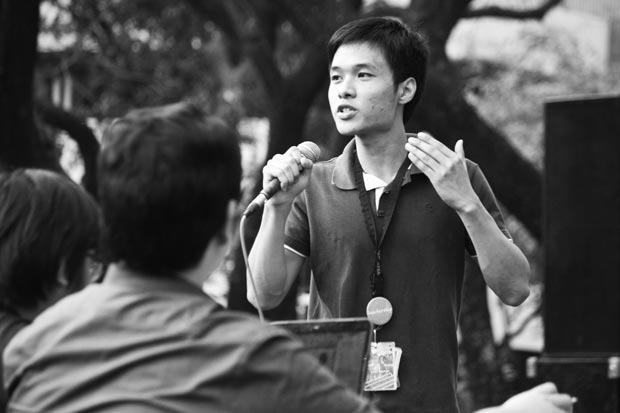
Photo by Ean L. Dacay


[…] Part 2: Crisis and transformation […]
[…] Part 2: Crisis and transformation […]