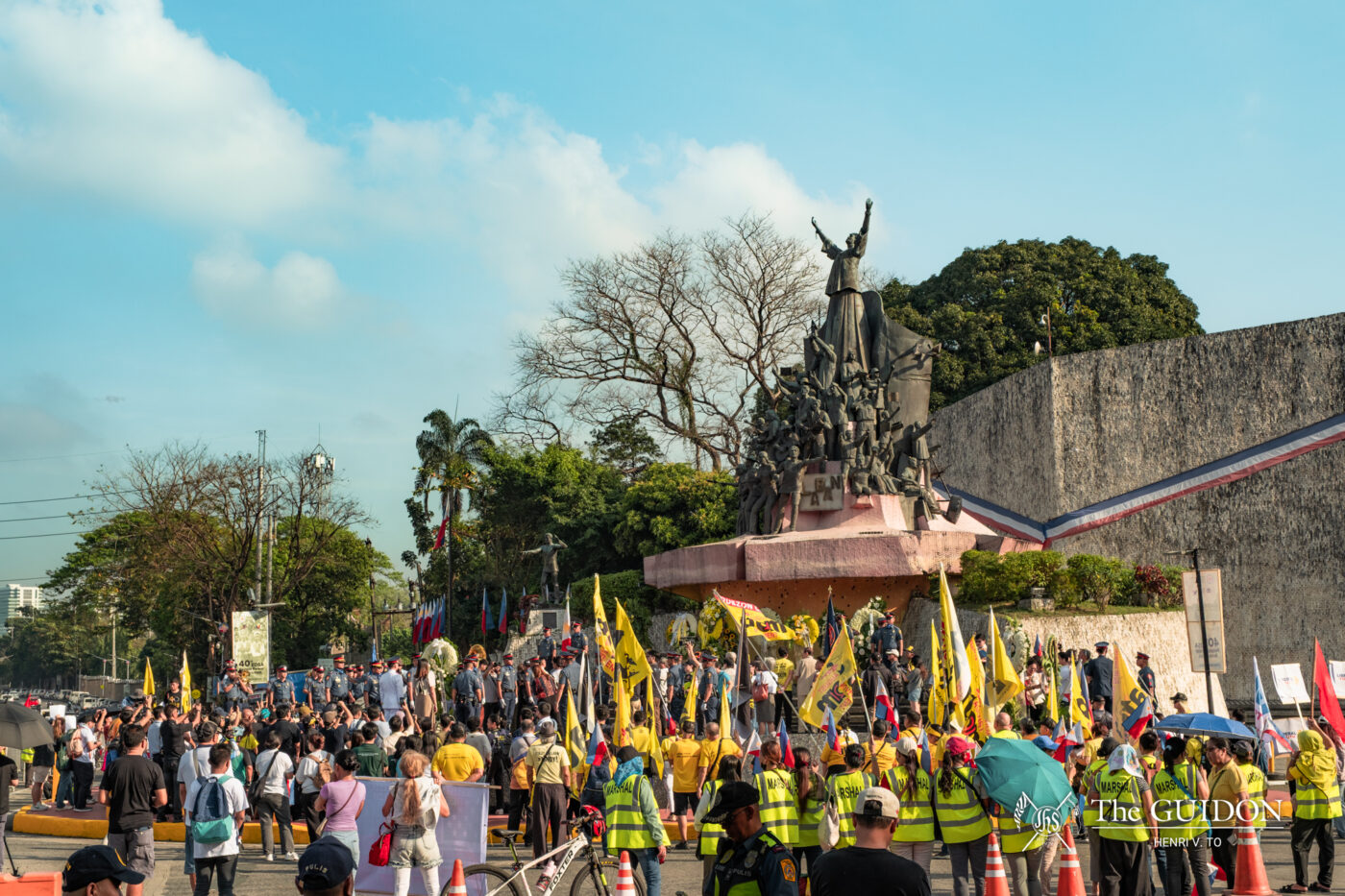
THE EDSA People Power Revolution continues to face distortion and defense, contesting its legacy and civic significance in contemporary times.
Revisiting EDSA
In 1986, the world praised Filipinos for overthrowing the oppressive and dictatorial regime of Ferdinand Marcos Sr., victoriously reclaiming the nation’s democracy.
Historically, the revolution sought to end the injustices of the dictatorship and democratically elect a new head of state. Corazon Aquino, wife of the late senator Ninoy Aquino and staunch Marcos critic, was supported by millions of Filipinos to become president in the February 7 snap election.
When Marcos was announced to have won, suspicions over electoral fraud rose. Citizens boycotted corporations, media, and banks that supported the Marcoses and their cronies. As Marcos’ inauguration neared, people began to march on Epifanio de los Santos Avenue (EDSA). By February 24, the avenue was swarmed with protestors who conducted a bloodless protest. Eventually, even the military defected and joined the people’s cause; tanks sent by Marcos refused to fire at crowds, while nuns offered flowers to the soldiers who pointed guns at them.
Radio Veritas covered the entire protest, withstanding technical failures by switching through different stations. On the evening of the protest, Marcos fled to the United States with his family after the live report of his inauguration was cut off. Filipinos cheered and sang ‘Bayan Ko’ upon confirming that the family had left. Corazon was then sworn in as President, and the nation’s democracy was restored.
This historic milestone has since been known as the People Power Revolution, a hallmark symbol of unity and democracy. More than that, EDSA was a testament to the success of a rights cause, as the end of the Marcos dictatorship also meant an ending to the human rights abuses it produced. Immediately after, the EDSA narrative manifested in infomercials and political non-fiction books. Over time, it was institutionalized in educational systems, civic participation, and the political landscape.
De La Salle University assistant professor and historian Michael Chua shared that the early anniversaries of EDSA were commemorated by gathering along the avenue itself. However, he noted that as fewer Filipinos participated, perceptions of EDSA also shifted, framing it as a nostalgic memory rather than a lived political reality. Thus, despite annual commemorations, the spirit of demanding better governance became a relic of the past.
“As years go by, especially during the time of Joseph Estrada, there would be crowds, but they aren’t as many [as before]. That’s when you will see that people are starting to view EDSA not as a thing of the present but as part of nostalgia,” Chua explains.
With each year that passes, EDSA narratives become more contested. For Chua, these disputes stem from the politicization, elite-catering reformative systems, and unmet needs of the masses. Debates emerged among the public, mainly about its success, legacy, and what EDSA means for Filipinos moving forward.
EDSA evolution
Over the decades, EDSA became material for political leverage, with people using their participation in the movement to forward their own agendas. The revolution, especially on social media, is not simply an event in history but a living, changing narrative—often used as a resource to reshape and consolidate public memory for power.
During the 1986 protest, the color yellow stood as a symbol of resistance against oppression. It also became the badge of honor of the Liberal Party (LP) and the Aquino family. Now, the same branding is weaponized to isolate and malign people.
Critics of the country’s current opposition party and its supporters use “dilaw” (yellow) as a disparaging term on the internet by simplifying yellow into a symbol of elite power, referring to the “failure” of the liberals to appeal to the Filipino masses.
August Twenty-One Movement President Voltaire Bohol expressed his frustration over the negative perception of the color yellow over the past decade. He stated that the reclamation of yellow as EDSA’s color is one of the reasons why the revolution is still contested.
On the other hand, most Filipinos perceive EDSA as an “unfinished revolution,” discussing it as a political or moral theory built on narratives that circulate on the internet. In the past, citizens acted as mere recipients of information about EDSA. However, with social media becoming a powerful tool for political discourse, contested discussions have emerged about its successes and failures.
After the 2022 elections hailed Ferdinand Marcos Jr. as the Philippine president, the revolution became an asset that either allowed for political gain or invoked its loss—dictated largely by the narratives that circulated online. As the Marcos family strives to reclaim their power, there have been attempts to downplay the EDSA commemoration, such as its removal from the list of public holidays. Now, with media platforms like Facebook more accessible than ever, people gained the freedom to contribute to the discourse no matter their beliefs, making the internet the primary platform for the erosion of its memory.
According to Chua, Filipinos have become participants in the battle for EDSA’s memory, especially with the emergence of echo chambers that aim to reduce the movement into self-serving political narratives.
As such, he added that merely recalling Philippine history is not enough. EDSA, much like the color yellow in its original context, was never the property of a single political faction but a representation of human rights and democracy. For Filipinos who stand for the truth, it has become imperative to defend the People Power narrative from disinformation campaigns that aim to dismantle history in the digital age.
Selective memory
Today, People Power remains present in the background of how political legitimacy is claimed and challenged. That is, invoking EDSA carries political implications in today’s protest scene.
EDSA’s once unifying symbolism now operates more like contested ground. Politicians across the spectrum, from the Marcoses and the Dutertes to the “dilawans,” cite or sidestep it depending on how it favors them. The revolution’s meaning has been repackaged to fit partisan interests, with its legacy invoked to support specific reforms or attack critics. This way, EDSA is no longer treated as a settled historical milestone, but as a tool in political messaging.
The ongoing debate over EDSA is proof that its legacy is politically charged. For Chua, however, 1986 should be seen as a completed chapter of history rather than a “continuing battle.” Reflecting on how the revolution drew global praise, he asked, “Why are we contesting our own brightest moment in front of the world? When the world loved the Filipinos, […] clapped their hands, [and] actually imitated the courage of the Filipinos [in starting pro-democracy movements like EDSA] to face the tanks and the forces of dictatorship around the world?”
Reclaiming EDSA, then, is not about repeating 1986 but protecting its core belief in collective, nonviolent resistance. As Bohol puts it, “It’s going to be a long journey to really reclaim the actual legacy of [EDSA], but we start by telling the real story. As long as we believe what happened 40 years ago, it’s not gonna die.”
Now, EDSA’s future as a political symbol remains uncertain. What remains clear is that control over its meaning continues to shape the boundaries of protest, participation, and democratic engagement.