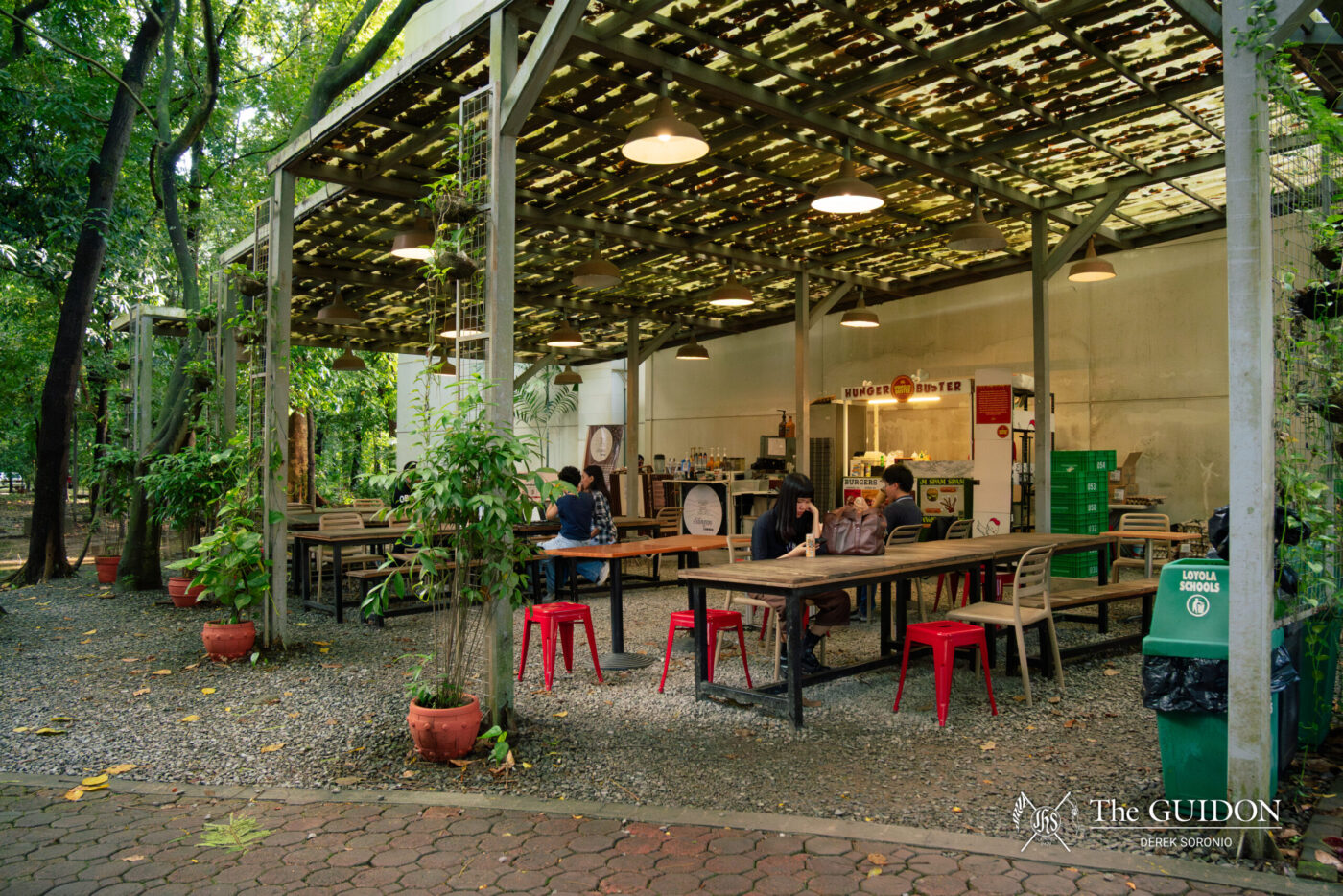
LAST AUGUST 5, Kitchen City and Varda Group officially began operations in the Gonzaga cafeteria, succeeding the Ateneo Multipurpose Collaborative (AMPC) as the main concessionaires. This transition also resulted in the relocation of beloved stalls Hunger Buster and Silingan Coffee, sparking growing unease over the future of Ateneo’s food landscape.
For the Atenean community, the management shift signifies the weight of modernization at the expense of livelihoods, sparking discussion about whose interests the administration ultimately serves.
Brewing changes
The decision to replace AMPC with the new concessionaires stemmed from a year-long competitive bidding process overseen by the University Business Affairs Office (UBAO).
According to Michael*, an Ateneo community member, Gonzaga cafeteria operations historically did not undergo a formal bidding process until this academic year. Previously, main concessionaires operated through automatic renewals rather than competitive selection.
He further explains that only the main concessionaires hold direct contracts with Ateneo, while smaller ones operate under them. As such, after AMPC’s contract expired, new agreements with Kitchen City and Varda Group granted them the authority to select stalls aligned with the University’s food safety and operational standards.
However, despite this decision-making power, Michael also highlights that the main concessionaires were still subject to a maximum number of stalls, as per UBAO’s instruction. Specifically, Kitchen City is allotted 12 stalls, while Varda Group is given 10.
Alongside the limits in stall allocations, Gonzaga also underwent renovations under the new concessionaires. Because of this, Michael notes that Hunger Buster, Silingan Coffee, and Potato Corner were temporarily relocated to the al fresco area by the New Rizal Library. When operations in Gonzaga resumed, he divulges that only Potato Corner returned since the other two offered coffee and burgers, which the new main concessionaires already offered.
Hunger Buster Manager Eries Nhoel Chan clarifies that his business now operates directly under UBAO, and not with either of the main concessionaires. “I was informed […] that I was no longer granted a stall [in Gonzaga], but I was still hopeful. I was still waiting for an update regarding my application, but […] I ended up not being granted anything,” he shares, in a mix of English and Filipino.
These developments reflect how management choices shape the market landscape within Gonzaga. Economics Department Associate Professor Noel De Guzman posits that encouraging market competition improves consumer welfare by ensuring fair product prices and providing a “differentiated” range of goods.
Hence, De Guzman suggests that business decisions should emerge from free competition and not restrictive limits. “In an ideal world, barriers to entry for businesses should be at the most minimal. [People] shouldn’t be prevented from opening their business,” he echoes.
However, the new market dynamics caused by management decisions prove to be a challenge for both Silingan and Hunger Buster, as they acknowledge that the competition present between many products played a factor in why the concessionaires were unable to continue in Gonzaga.
Given this context, De Guzman recognizes that it is normal for small “firms” to be overshadowed by larger ones, as attested to by Chan’s experience. The latter shares that the relocation brought uncertainty about the stability of his business’ future on campus, as they had already built a steady presence in Gonzaga over the years.
Shaky grounds
Amid these changes, the livelihoods of the employees from Hunger Buster and Silingan Coffee are directly affected.
For Silingan Coffee Manager Lourdes de Juan, she thought that their time operating within the Ateneo campus had come to an end before being transferred to the New Rizal Library. “[Nalungkot] kami kasi ‘di namin alam kung saan kami ililipat (We felt sad because we did not know where we would move to),” de Juan expresses.
Similarly, Chan remembers feeling shaken when he received the news that his stall would no longer be included as a Gonzaga concessionaire for this academic year. He grew worried for the job security of his long-time employees who had come to rely on the stall for their livelihood.
Chan explains that part of this fear arose because the al fresco area simply acts as an extension to the library, where students just happen to pass by the food stalls outside. Hence, these stalls are not actively sought out by students when buying food.
Apart from geographical concerns affecting the two stalls, operational challenges also occurred due to the relocation. Silingan Coffee experienced difficulties working amid inclement weather, while Chan notes that Hunger Buster management had to increase protocols for food safety due to the open-air environment.
Subsequently, de Juan explains that there is a noticeable decline in the revenue of Silingan Coffee compared to their time in Gonzaga.
Despite this, de Juan remains grateful to the UBAO for finding ways for Silingan Coffee to continue operating in the Ateneo. “Hangga’t may trabaho ako, nabibigyan kami ng pagkakataon na magkaroon ng hanapbuhay (As long as I have a job, we are given opportunities to make a living)” de Juan shares.
With this, Michael emphasizes that the University continues to support small concessionaires by inviting them to University events, providing them operational spaces, and assisting them in negotiations with main concessionaires like Kitchen City and Varda Group.
Refilling the cup
Despite existing efforts, De Guzman points out that customers themselves can play a substantial role in reshaping this dynamic between concessionaires so small businesses can still thrive. He stresses that preserving consumer sovereignty is crucial in ensuring that customers make their voices heard.
De Juan echoes the need to center business decisions on customer experience, emphasizing the importance Silingan Coffee places on the students they serve. “Gusto din talaga namin na makasama namin yung mga estudyante, makausap sila, at [marinig] din ‘yong mga sinasabi nila (We truly want to be connected with the students, speak to them, and also hear what they have to say),” she affirms.
In exchange, Silingan Coffee Barista Isay Sarmiento hopes that the student consumers recognize the deeper advocacy of their business. She underscores that a stable place to serve coffee allows them to continue sharing their stories as widows of extrajudicial killings.
Sarmiento further asserts that their livelihoods not only entail serving coffee to the students, but it also serves as a platform for the Atenean community to hear their voices and struggles.
Thus, De Guzman emphasizes the importance of supporting stalls “with your feet and wallet.” He urges consumers to make well-informed decisions about supporting stalls where they think their money is more respected, regardless of location and convenience.
Ultimately, these decisions compel the Ateneo to further strengthen its commitment and embodiment of being “persons with and for others” by pushing for more economic inclusion. Hence, the challenge hinges on creating a system that prioritizes livelihood, especially for the stall owners and workers who are most affected by these new changes in management.
*Editor’s Note: The name of the interviewee has been omitted to protect their identity and privacy.