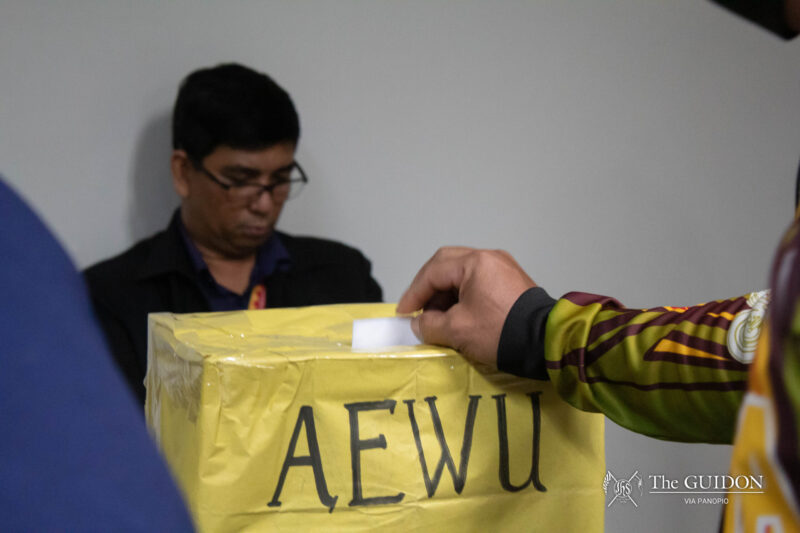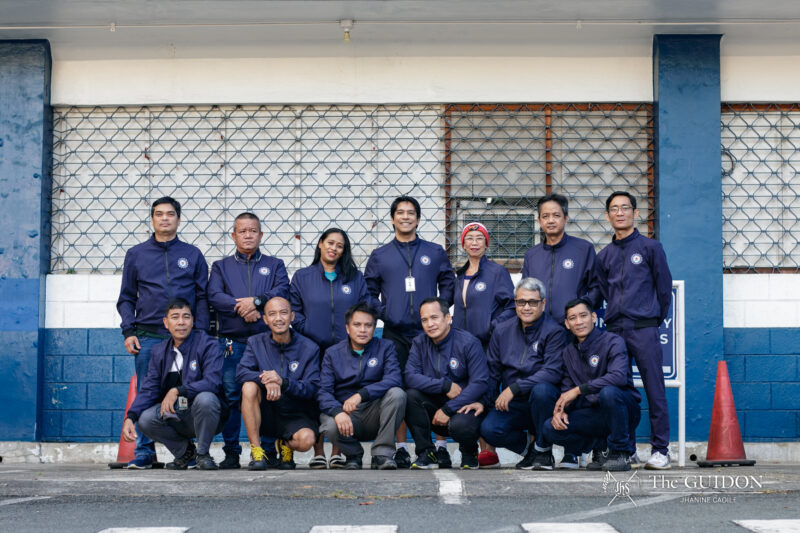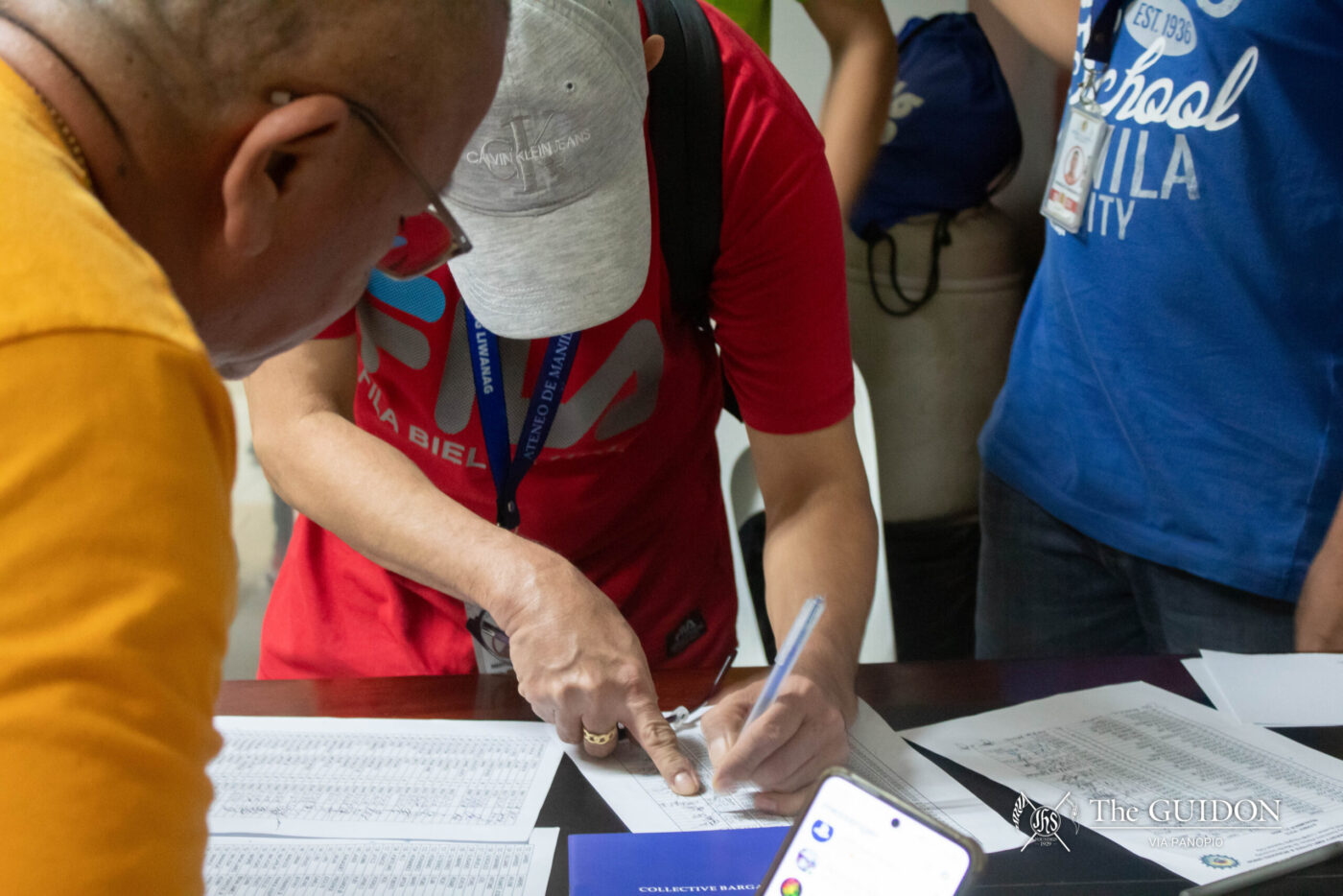
AFTER FILING a Notice of Strike (NOS) against the University due to alleged unfair labor practices (ULP), the Ateneo Employees and Workers Union (AEWU) voted to proceed with the strike. Notably, 162 members voted “yes” and 66 voted “no” during the voting process held on November 21 at the Union Office, University Dormitory Basement.
The strike vote occurred after a series of conferences with the National Conciliation and Mediation Board (NCMB), where AEWU and Ateneo relayed their arguments and determined remedies regarding the dispute.
Following the submission of the strike vote results on November 24, a seven-day strike ban was observed until December 1. During this period, conciliation conferences have continued, with the most recent one scheduled on December 1. As of writing, no official announcements have been made on new developments.
In explaining the basis for the NOS, AEWU President Raymond Tano stressed that the Union’s ULP allegations included the University’s indiscriminate filing of charges, baseless suspensions and charges against Union officers and members, harassment, and abuse of authority from superiors.
Adding to these allegations, Tano claimed that the University administration interfered with Union activities and violated the 2024–2029 Collective Bargaining Agreement (CBA) by not involving the Union in drafting the Work Rotation Program (WRP) and suspending over 70 Union officers and members.
As a response to these arguments, the University released a position paper on October 28 and a statement on November 6, contending that the suspensions were carried out with due process.
According to the University statement, due process in these disciplinary sanctions involved “written notices, hearings, and decisions,” including the filing of a Notice of Charge (NOC)—a document issued to an employee who allegedly committed an infraction. This provides an opportunity for the employee to reply within five days after receiving the NOC.
The statement further clarified that disciplinary measures were imposed due to individual acts of defiance and operational disruptions, rather than for the purpose of interfering with union affairs.
Root of the tensions
Cited by both parties as the root of the issue, the WRP was explained in the University’s statement as a program “designed to enhance flexibility, morale, and professional development” among the Custodial Services Group.
Moreover, the University’s statement refuted allegations of violating the CBA, noting that consultations on the WRP were held with various stakeholders as early as March 2024.
In its position paper, the University further highlighted that AEWU officers agreed to comply with the WRP, albeit “under protest,” on May 31, 2024. However, Tano stated that the University merely presented already drafted policies with implementation dates, arguing that this does not constitute genuine dialogue.
He stressed that, based on the CBA, the AEWU’s involvement in the drafting process of the program is necessary to assess its impact on the workers’ rights, benefits, and welfare.
The University position paper also claimed that prior to the WRP’s initial implementation on September 9, 2024, stakeholder roadshows, walkthroughs, and shadowing sessions were held.
On the WRP’s implementation day, however, several Union members reportedly refused to comply according to the University’s statement, leading to the “disrupt[ion] of university operations and violat[ion] of lawful management directives.”
This led to the first case of imposed suspensions, where a total of 51 maintenance staff failed to comply with the WRP, as detailed in the University’s position paper. Meanwhile, the second case centered on allegations of unauthorized meetings during work hours, in which 30 out of 48 initially charged employees were found guilty.
AEWU’s cross-examination
Disputing the University’s findings, Tano noted that the administration relied heavily on CCTV footage to substantiate the allegations. He asserted that such recordings lacked sufficient context to determine if misconduct had actually occurred.
He added that due process should involve gathering “substantial” evidence and consulting with the accused on the alleged violation’s context, which he claimed the administration did not do before filing the NOC.
Tano also raised concerns over the varying lengths of suspension the administration imposed on Union officers, despite what he described as identical infractions among those sanctioned. For him, the inconsistencies in penalty durations suggested arbitrariness in the process. Meanwhile, the University’s statement maintained that all disciplinary actions were applied “equitably and proportionately.”
With regard to the unauthorized meetings, Tano shared that the University had yet to show proof that operations were disrupted or that any unit lodged a complaint about being affected.
He further explained that the brief September 5 gathering was held, as members sought guidance from Union officers following their WRP transfer orders. He mentioned that it was not a non-work-related activity, since providing such advice is part of their CBA-mandated duties as officers.
Nonetheless, the University argued that the gatherings reflected a concerted effort not to follow the rotation schedule, hence violating University policies.
Further questioning the fairness of the University’s disciplinary process, Tano claimed that there were even cases of AEWU members receiving NOCs while on sick leave during the alleged incidents of violations.
Notably, the Office of the Vice President of Administration declined The GUIDON’s interview request, stating that the Human Resources (HR) Office is “better equipped to respond” regarding the matter.
However, University Marketing and Communications Office Director Maria Teresa Villanueva rejected an interview with The GUIDON on behalf of the HR Office, clarifying that “disciplinary measures are not within the purview of the Human Resource Governance Section.”
She further explained that all information on the Ateneo’s position is already contained in the released statements and position paper, so no further statements will be issued beyond these.
Mediation and resolution
With the NOS filed on October 23 due to allegations of ULP and CBA violations, a 15-day cooling-off period followed to provide an avenue for the AEWU and administration to work toward a resolution, with the aid of NCMB.
During this period, Tano shared that conciliation meetings were conducted to exhaust all possible means to resolve the conflict.
Within these meetings, Tano asserted the Union’s position, which called for the reversal of the WRP, so employees could return to their previously designated areas where they had worked efficiently.
Moreover, the Union also demanded payment for the days when workers were allegedly illegally suspended, as well as the removal of these violation records from their 201 file. However, Tano mentioned that the administration replied with counterconditions, insisting that the WRP remain.
Tano said the administration told the Union to instead pursue its ULP allegations with the Department of Labor and Employment (DOLE) through voluntary arbitration, which should determine the validity of their allegations on the University’s interference with Union activities and violation of the CBA.
During this period, tension also arose among Union members alongside the mediation processes, with several Union members raising concerns about the grounds and timeline of the NOS filing.
For the concerned circle, the filing of an NOS felt insufficiently communicated, prompting greater calls for transparency within the Union. The statement further stressed the need to examine issues surrounding the strike to ensure clarity and understand its implications for the livelihoods of affected Union workers.
Despite conflicting views between Union members, the majority voted to proceed with the strike. Following this, the University released a statement on November 25, asserting that the call for a strike was “baseless and unwarranted.” The administration emphasized that the contested disciplinary measures were unrelated to the employees’ Union affiliation and that due process was observed at every stage.
The same statement also pointed out that the NOS was filed just a day after two Union officers appealed their respective sanctions, suggesting that the move for a strike “appears [to be] tied to [their] individual disciplinary cases, rather than a legitimate collective grievance.”
During their conciliation meeting on November 24, the University mentioned that both the Ateneo and AEWU maintained their respective positions on the dispute. While no further announcements have been made official, Tano shared on December 1 through a Facebook post that the DOLE Secretary has assumed jurisdiction over the case and that the Union respects such order.
Editor’s Note: This is a developing story. More updates will follow regarding the issue.
With reports by Ashley Enriquez and Nicole Anne Kelsy Sy