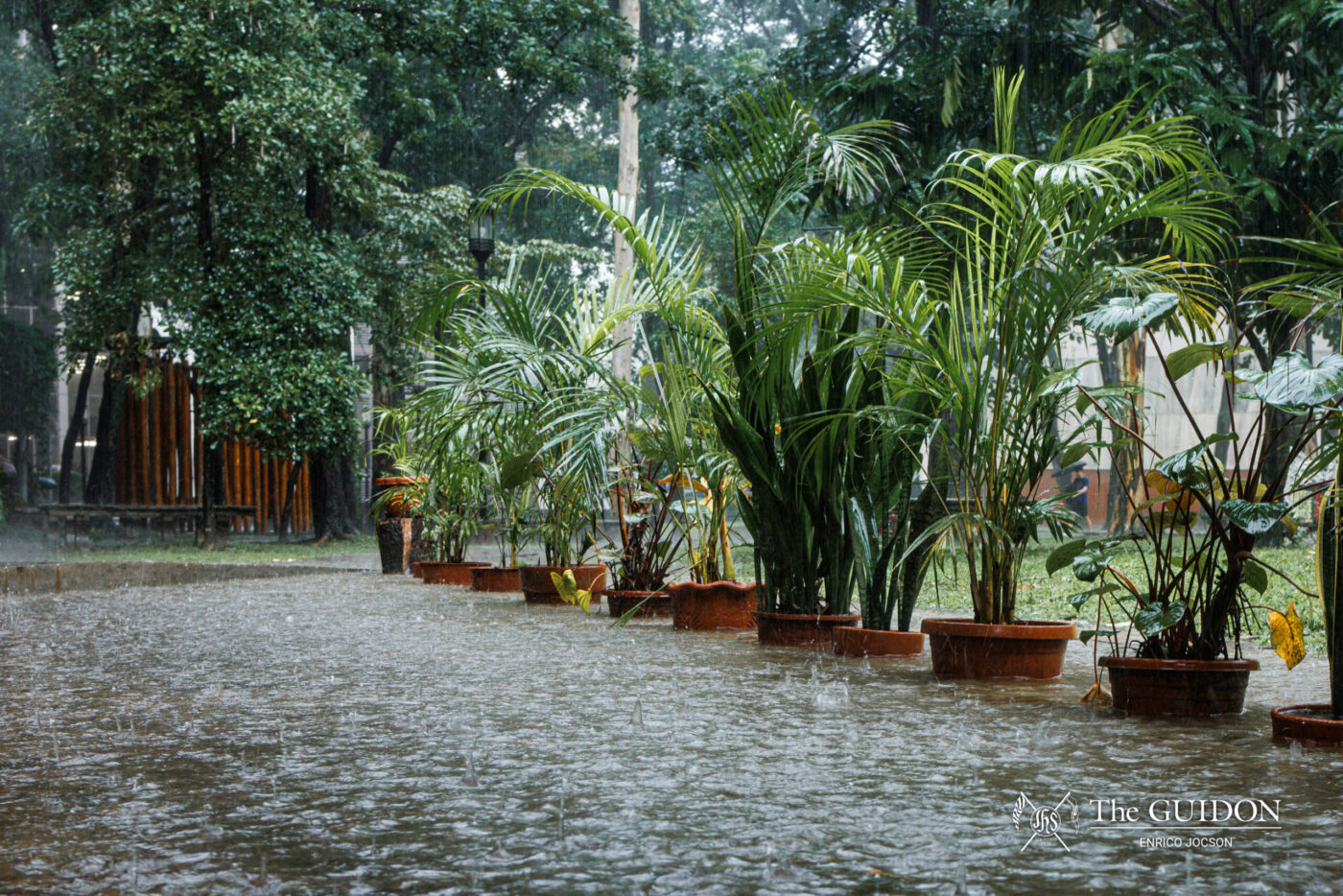
TO MITIGATE the impact of flooding occurrences within campus, the University administration shared plans to strengthen the school’s drainage systems, develop flood containment areas, and integrate long-term sustainability measures.
Due to thunderstorms and heavy rainfall, flooding incidents occurred on August 30 and September 29, affecting many areas in the Ateneo, such as portions of the Basic Education (BE) Unit, the Science Education Complex (SEC) foyers, the Gonzaga cafeteria, Zen Garden, Dela Costa Hall, Gates 2 and 3.5, and the Institute of Social Order (ISO) complex.
Vice President for Administration Rodolfo Ang noted that flooding of such severity has never occurred in the Ateneo, citing Typhoon Ondoy in 2009 as the closest incident. However, Central Facilities Management Office Director Michael Canlas clarified that the Ondoy flood was limited to Katipunan Avenue and did not reach the inner areas of the campus.
Acknowledging that future rainfall of the same intensity remains possible, Ang underscored the need to study the causes of flooding as well as formulate immediate and long-term responses.
On the students’ end, Sanggunian School of Science and Engineering Representative Ma. Francesca Montaña highlighted the mobility and safety issues resulting from the recent flooding.
Stop-gaps and solutions
Elaborating on the potential causes of campus flooding, Ang cited the increase in rainfall and backflow of floodwater from typical drainage discharge points, such as Katipunan Avenue and the creek between the Ateneo Loyola Heights Campus and Miriam College.
Moreover, Canlas explained that the University’s sloped terrain results in rainwater flowing toward lower areas, causing water buildup near buildings and other flood-prone zones.
As such, he mentioned that the administration plans to build swales and containment areas, like detention ponds, to help slow down rainwater discharge from the campus. Notably, Ang added that the administration is currently identifying appropriate locations for these structures, which may be installed within the academic year.
Contextualizing the current flood control systems, Ang explained that the Ateneo’s sewage and drainage mechanisms were built before campus expansion and the worsening climate conditions. As a result, these systems were not designed to handle the present volume of rainfall and runoff.
To address this concern, Ang underscored that the University plans to consult experts who will conduct a full campus drainage system assessment and recommend structural measures to strengthen its flood management capacity.
He added that, in the long term, the administration aims to collaborate with the Quezon City and Marikina City local government units in addressing the broader drainage issues that affect the cities surrounding the Loyola Heights campus.
Explaining the progress of the University-wide flood control plans, Ang shared that the administration is currently refining them before holding community-wide consultations. He also emphasized that these plans are still subject to approval and consultations with stakeholders.
“We would like to hear student opinions, but […] consultation doesn’t mean we’ll always accept or agree with [the suggestions], but we’d like to hear your concerns, just as we’d like you to hear ours,” Ang stressed.
With this, Montaña emphasized the importance of genuine dialogue, calling for transparency and openness from the administration towards student concerns.
As of writing, Ang mentioned that the administration is preparing to conduct consultations with stakeholders, including experts on flood control and drainage, the BE Unit, the Higher Education Unit, auxiliary units, and student groups, before implementing any concrete plans.
Wading through water
Looking into student experiences, Ateneo Environmental Science Society President Juliana Beatrice Lirios shared that the flooding disrupted student mobility, as Ateneo’s spread-out layout requires students to move between buildings.
During both floodings, Montaña said that the Sanggunian coordinated student concerns with the Ateneo administration and the Office of Student Activities through Messenger-based constituency checks. She added that the student government collaborated with the Ateneo Disaster Response and Management Team for logistical and relief efforts.
However, despite these response measures, Lirios expressed that the University may not yet be fully prepared for hazards intensified by climate change. She explained that flooding of such a scale rarely occurs on campus, so planning for such an event was likely not prioritized, in contrast to other risks like earthquakes.
Pointing out the students’ growing frustration, Lirios stressed how ongoing campus construction has worsened the flooding situation. To address this, she added that the administration should focus on expanding the campus’s blue-green infrastructure, which can absorb rainfall and address the impacts of climate change.
Climate-resilient Ateneo
Beyond addressing outdated drainage and building flood control infrastructures, Manila Observatory Executive Director Jose Ramon Villarin, SJ, highlighted that tackling these issues requires a call for collective responsibility.
He emphasized that fostering a disaster-prepared and environmentally responsible Ateneo involves not only structural interventions, but also active participation from the entire community.
“We want to instill […] good habits [and a] culture of care for the commons. […] We have nice plans, but it’s [the] execution [and] engagement from everyone [that can make a difference] to help our campus,” Villarin expressed.
In addition to flood mitigation projects, Ang stated that the administration also plans to strengthen the current disaster preparedness framework across all Ateneo campuses to ensure safety for the entire community.
With this vision of safety in mind, Ang affirmed the University’s commitment to remain proactive in addressing climate- and disaster-related concerns by implementing initiatives designed to anticipate and prevent unsafe conditions before they arise.