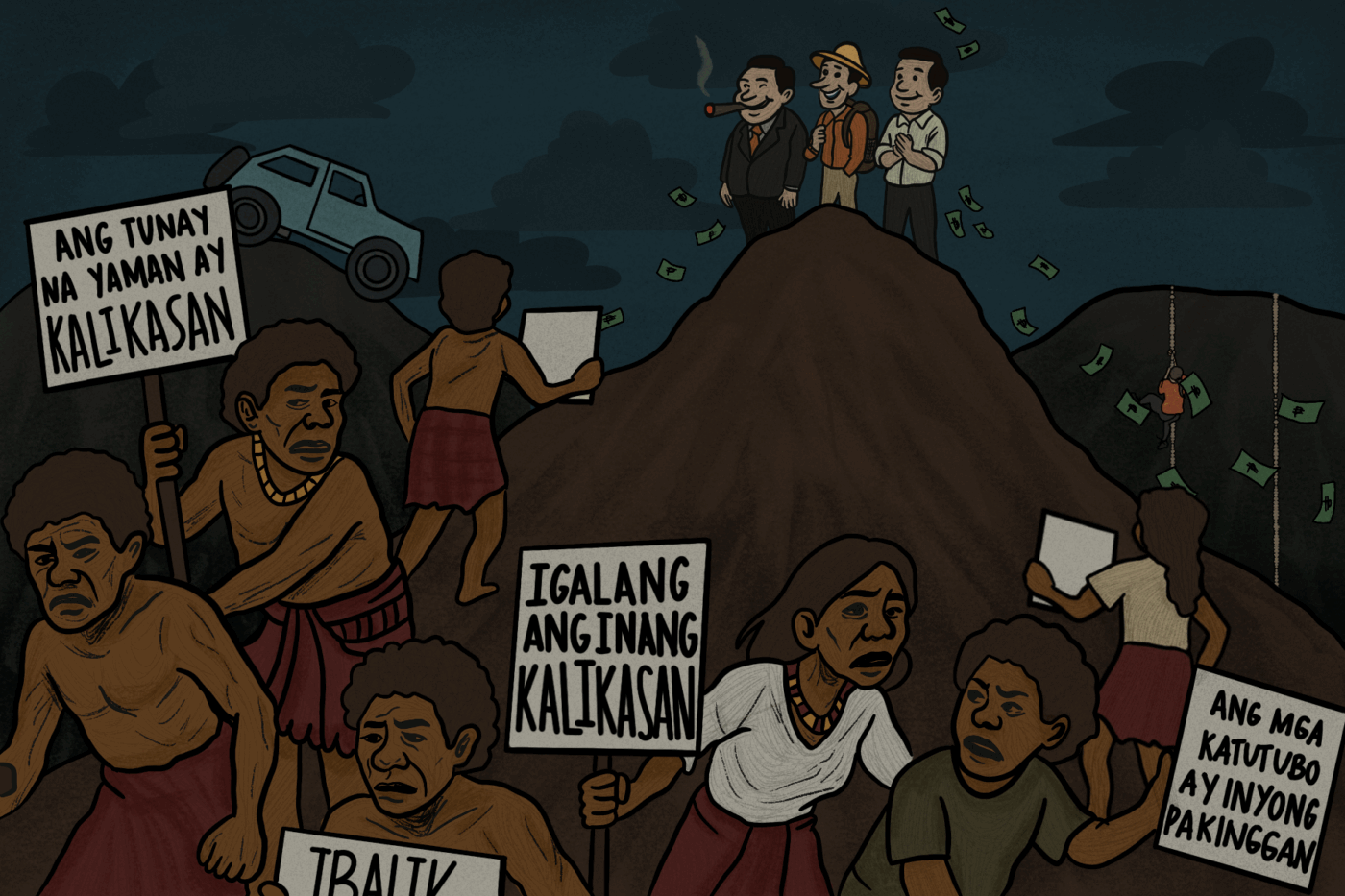
FOLLOWING ITS eruption in 1991, Mt. Pinatubo became an attractive place to promote a more sustainable form of tourism, called “ecotourism,” which aims to minimize environmental disturbance, conserve cultural heritage, and mutually uplift local populations.
While ecotourism has driven up Mt. Pinatubo’s post-eruption revival, the climb to equal rights and recognition remains steep for many of its own people. In April, Aeta communities residing in Mt. Pinatubo blocked tourists from accessing the trail toward the mountain’s crater in protest against being excluded from the tourism industry built on their ancestral lands.
More than an act of defending their rights, the Aeta communities’ demonstration exposes a deeper gap in ecotourism between development blueprints and the lived realities of Indigenous communities, who are still denied participation in the projects and decisions shaping their lands.
Development for whom?
In their display of determination, the Aetas’ barricade reveals the alleged exploitation of their community. Despite their involvement in tourism-related activities, their toils continue to be undeservedly acknowledged.
Among the Aetas’ complaints to their local government is inadequate income for their work as guide treks on the trail. Receiving only a minimal portion of the revenue generated from local tourism and being paid less than the country’s minimum wage, members of the community struggle to sustain their basic necessities and fund the education of their children.
Aside from unfair monetary compensation, they also lamented the tourism industry’s disregard for their ancestral domain. Similar to the Ati in Boracay, the Aetas around Pinatubo were only granted the Certificate of Ancestral Domain Title (CADT) in 2009, despite inhabiting the land for generations already.
Nevertheless, the CADT did not impede operators and private entities from establishing businesses near Mt. Pinatubo, while leaving the indigenous folk unrewarded.
Ateneo Law School Formation Director Atty. Katrina Isabel Blanco noted that the indigenous prioritize preserving the condition of their environment, as that is integral to their concept of survival and development. She explained, “This is [their home]. This is [their] land, and to them, it means so much—and oftentimes, they’re left at the losing end.”
This misalignment of development goals between the local tourism industry and the Aeta community has resulted in brewing tensions over tourism operations. As local tour operators and the local government office devise schemes to maximize profit, Blanco said that “equitable and sustainable tourism” risks being reduced to a catchphrase until indigenous communities holistically benefit from it.
Conflicting interests
International Ecotourism Society Philippines Founder Vilma De Claro Mendoza remarked that even with legislation, such as the Indigenous Peoples’ Rights Act of 1997 (IPRA), safeguarding the interests of Indigenous Peoples (IPs) remains insufficiently enforced.
She identified several factors intensifying the disenfranchisement of the indigenous communities, including government corruption, a lack of resources to access legal support services, and superficial consultation on tourism development plans.
Similarly, Blanco asserted that the Philippine legal system alienates the IPs by enabling land-grabbing and forced evictions from their ancestral domain.
Such is the case for native Bugsuk residents in Palawan, who continue to receive threats to their livelihood and security after resisting San Miguel Corporation’s (SMC) plans to develop the island it claims to own. The rightful owner of Bugsuk remains a contentious legal battle, as IPs in Palawan are yet to be awarded their CADT, while SMC firmly maintains the validity of their title, which precedes IPRA.
In other instances, private entities would often present a tax declaration to contest indigenous ownership of lands, whereas the law stipulates that ancestral domains and lands are acknowledged by virtue of Native Title. With the insistence of development corporations to take over ancestral lands, often permitted by the local government, indigenous groups are left to defend themselves against systemic marginalization, where their rights are deemed invisible without a paper to prove entitlement.
This repeated lack of inclusion and representation of Indigenous communities in legal frameworks raises broader challenges to the very principles and interests that the ecotourism industry claims to uphold.
De Claro Mendoza pointed out that the displacement and marginalization of Indigenous communities violate the essence of sustainable tourism, whose principles are meant to safeguard their well-being and right to self-determination. She stressed that tourism growth can indeed coexist with the protection of IP rights, but only through a fundamental shift in approach. “This requires a collaborative, participatory model where indigenous communities are active partners, not passive recipients, in tourism development,” she asserted.
Blanco likewise underscored the importance of including IPs at every stage of the economic management of tourism operations. She clarified that IPs are not against development projects. Rather, they only demand that their right to self-determination be recognized.
To further illustrate her point, she cited the case of Culion, Palawan, where tourism sites were developed through land-grabbing and the destruction of mangroves to produce white sand. Meanwhile, in Sta. Ana, Cagayan, sustainability is practiced by enabling local Agtas to build model homestays for tourists, create museums and heritage sites, and pursue livelihoods beyond subsistence.
This contrast illustrates how the enforcement—or disregard—of laws and its principles can shape ecotourism into a tool for further marginalization or a space for genuine, community-led development.
Reframing “sustainability”
For Blanco, Indigenous locals’ deep knowledge of their land merits an expanded role in tourism growth. She remarks that the extent of their engagement should not be limited to receiving incomes, but must also include being involved in and witnessing the development process and outcome.
One mechanism meant to safeguard such inclusion is the principle of Free, Prior, and Informed Consent (FPIC), which requires Indigenous communities to be meaningfully consulted before any project involving their lands proceeds.
De Claro Mendoza frames sustainability and equitability in tourism planning through an enforcement lens, stressing the joint role of the government, private sector, and civil society in ensuring that “tourism benefits both visitors and indigenous communities” and “respects their rights and cultural heritage.”
Ultimately, the struggle to protect Indigenous peoples’ rights in tourism and development goes back to the agency of Indigenous peoples themselves—and whether it is fully understood, respected, and freed. As experts emphasize, the issue lies not in pursuing development, but in ensuring that no one’s rights are trampled in the process.
Without acknowledging this call, the ecotourism industry risks further marginalizing and displacing Indigenous communities in the country’s cultural and economic spaces. Addressing this gap significantly depends on whether tourism can progress into a space where Indigenous peoples are not mere beneficiaries but indispensable partners in building a truly sustainable future.