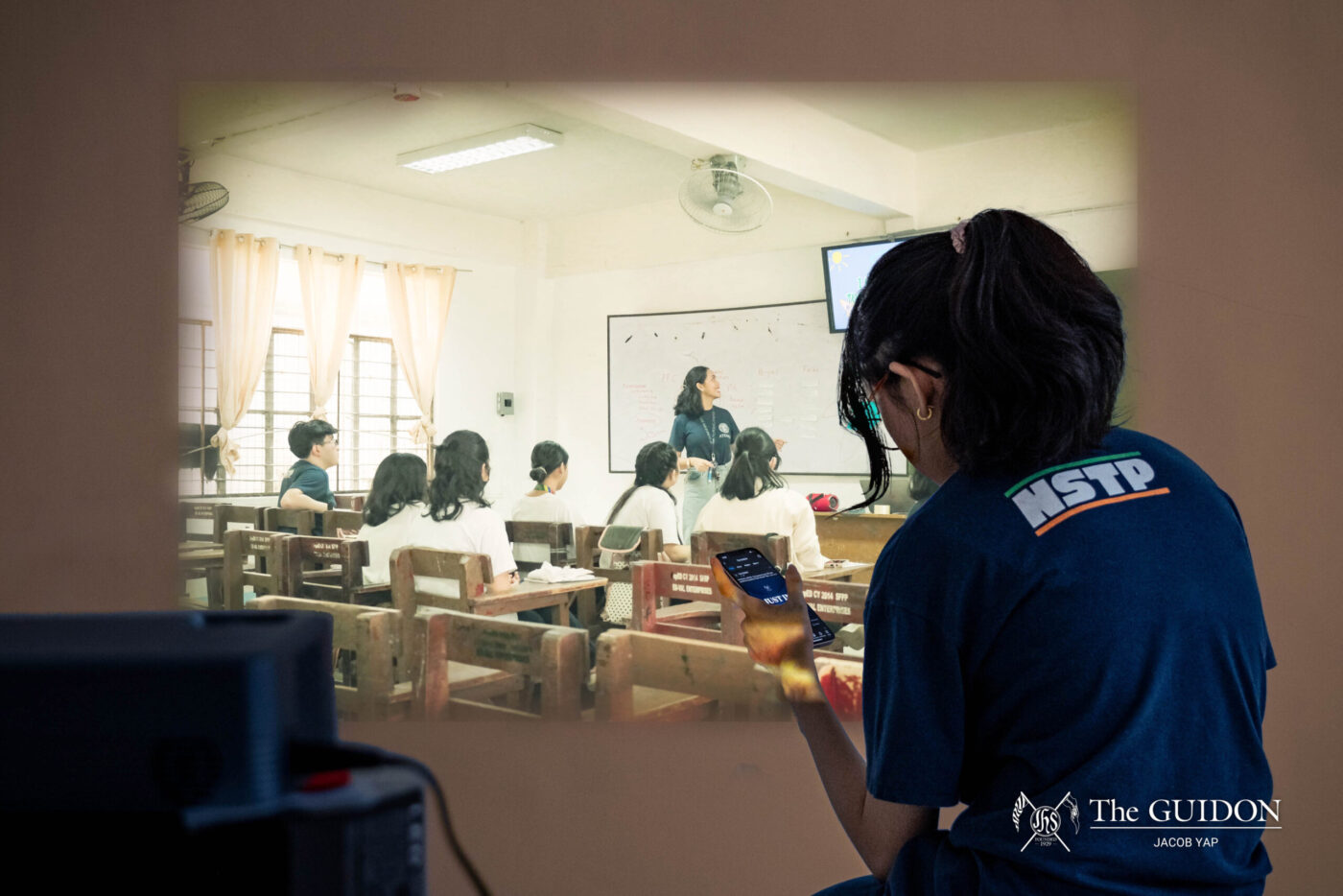
WHILE THE Ateneo envisions itself as a “leader” in social transformation, recent concerns over the University’s required formation programs suggest otherwise. Students stress that the shallow reflections and performative engagement continue to circulate and spark doubts on the effectiveness of these initiatives.
With formation programs such as Binhi, Punla, and Bigkis’ aim of engaging students with communities, questions are raised on whether these programs truly shape students who are ready to “go down the hill.”
Structural strains
The formation programs of the Office for Social Concern and Involvement (OSCI) seek to foster connections between Ateneans and marginalized communities. OSCI Binhi Formator Sergio Andre Gerardo Gabriel, MA affirms this, noting that the programs are designed for students to cultivate greater social involvement while applying their disciplines.
For One Big Fight for Human Rights and Democracy (OBFHRD) Convenor Mara De la Cruz (2 AB DS), she shares that this objective was “drilled in” for her class. Hence, she observed that her peers were able to authentically connect with their partner community, “Tahanang Walang Hagdan,” during their area engagement.
However, emerging concerns suggest that there may be a disconnect between the programs’ goals and the students’ actual experience. In particular, some have commented that the programs encourage students to view their partner communities as “spectacles,” underscoring deeper structural issues.
Reflecting on his own experience, Jesther Resuello (4 BS PSY) believes that Binhi, Punla, and Bigkis all fulfill the University’s goal to form persons for and with others. However, he observes that their emphasis on academic performance may often overshadow meaningful student participation.
De la Cruz echoes a similar concern on the “transactional” nature of the program’s structures. “[The programs may treat] integration into different sectors of society as something you have to do for an end—which is […] to pass the class, to finish your requirements—instead of as a means to truly learn more about society,” she says.
At the institutional level, Department of Sociology and Anthropology Lecturer John Abletis, MA points out that Commission on Higher Education (CHED) regulations, such as the requirement for local government unit approval for off-campus activities, can pose a challenge for students to maximize their time in fully immersing themselves with their partner communities.
These shared concerns of both the students and faculty underscore existing challenges beyond the programs’ structures, preventing them from forming meaningful connections with partner communities.
Beyond the motions
While questions around structure persist, the deeper concern lies in how students internalize these engagements. “I realized that the main takeaway of some people is […] ‘Thank God, this isn’t my life,’” De la Cruz observes. With this, she highlights how this lack of depth may leave students disillusioned rather than meaningfully connected.
For De la Cruz, this is a manifestation of an education system that prioritizes individual achievement. With students’ focus on the need to excel, the system itself holds them back and veers their attention away from building their sociopolitical consciousness.
“We’re forced to think about ourselves all the time. We’re forced to think about our future, and not the future of others. […] We have that privilege,” De la Cruz emphasizes.
In this regard, Abletis cautions against a mindset rooted in noblesse oblige—a sense of duty where people with privilege offer help out of obligation, rather than solidarity. He states that this tendency is often present among elites.
Such a perspective, he explains, may only reinforce cultural divide—one that hinders students and partner communities from truly understanding one another from forming genuine person-to-person connections.
Drawing from sociologist Pierre Bourdieu’s concept of cultural capital, Abletis explains that students’ predispositions—shaped by their upbringing and social class—may prevent them from fully understanding the lived realities of communities they aim to engage with. Often, students enter these spaces with perspectives far from those of the people they wish to help.
Resuello echoes this, highlighting that some students may be hindered from fully engaging themselves due to their disinterest or lack of preparedness and exposure to immerse themselves.
Recognizing its impact on the students’ sense of civic responsibility, Abletis stresses the need to bridge the disconnect between students’ privileged social backgrounds and the lived realities of partner communities—especially with the Ateneo’s emphasis on addressing such cultural divides.
Abletis explains that while the University functions as a think tank, the knowledge it produces must remain relevant and responsive to societal needs. In the end, he emphasizes, the University must keep the communities it seeks to serve at the center of its work.
With this, Gabriel highlights that formation programs can only be truly effective if students build a sustained personal relationship with the communities they work with and serve. As concerns regarding disingenuous formation persist, they point to deeper questions not just about structure, but about the lenses through which students engage.
Toward meaningful engagement
Improving formation requires shifts in both mindset and concrete program design. For Abletis and Gabriel, this involves extending immersion beyond a single day.
“You can’t expect [students] to go [to their partner communities] on a one whole day trip, and then suddenly their life is going to change drastically. I think it’s insulting the capacity and intelligence of our students also […] because in reality, they’re all coming from a specific place,” Gabriel asserts.
Moreover, Abletis suggests strengthening the integration of formation programs with academic subjects apart from the Social Sciences and Theology. By doing this, he notes that students across disciplines can better connect their coursework with real-world social issues.
While improvements in structure can guide more meaningful engagement, Abletis emphasizes that the University must be able to empower its students to create an impact. Ultimately, however, he stresses that it is up to the students to go beyond what the institution offers.
In this light, De la Cruz highlights the importance of participating in political education discussions, especially those led by socio-political organizations, as these can be valuable starting points for students to deepen their awareness. For her, such spaces not only encourage critical discourse but also prepare students for sustained civic engagement by exposing them to the lived realities beyond the University.
“Our task as the youth is to learn about society, not just in our classrooms, but outside, in communities, in the streets, in mobilizations, in discussions,” De la Cruz underscores.
Meanwhile, Resuello proposes a more internalized approach—introspection—urging students to decenter themselves, setting aside their own biases and privileges, in order to truly learn from the communities they aim to engage with.
Ultimately, authentic formation cannot rely on intention alone. With structural limitations and underlying biases unaddressed, formation programs like Binhi, Punla, and Bigkis risk widening the gaps they wish to bridge.
This calls for critical reflection—both on the design of these programs and the perspectives students bring—to go beyond campus, and genuinely engage with the lives of the communities they wish to serve.