TO REINFORCE campus security, the Ateneo has begun implementing a Radio-Frequency Identification (RFID) access system since July 21, while also planning the installation of additional closed-circuit television (CCTV) cameras across the Loyola Heights campus.
With this development, students and employees are expected to scan their RFID-enabled Ateneo identification cards to enter and exit University premises starting September 15. Meanwhile, vehicles issued with RFID tags are required to enter through RFID-only lanes.
According to an email correspondence with The GUIDON last August 13, the University administration said that the new RFID and CCTV systems are part of Ateneo’s “ongoing efforts to strengthen campus safety and ensure secure access to University premises.”
Recent updates
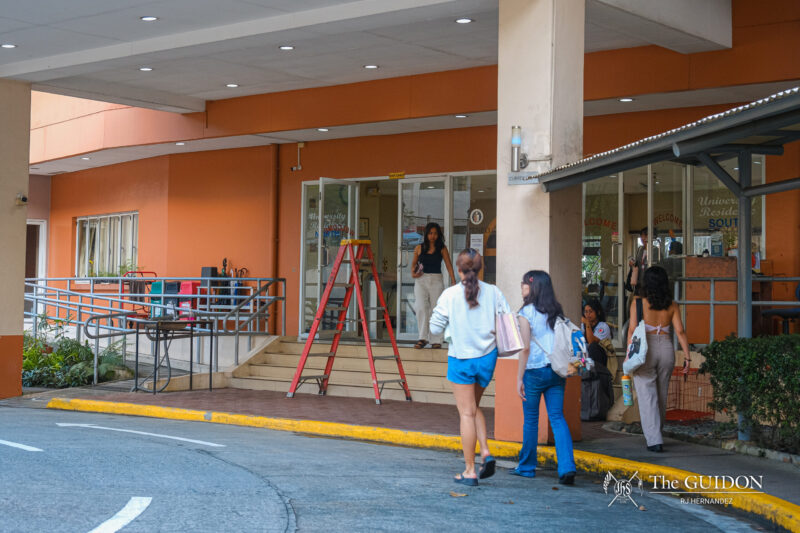
In line with the security enhancements, the new RFID systems include turnstiles for pedestrians and boom barriers for vehicles. As of writing, RFID turnstiles have been deployed at Leong Hall, Xavier Hall, University Residence Halls, New Rizal Library, and pedestrian gates.
Moreover, additional CCTV cameras are scheduled for installation in public places around campus, such as classrooms, theaters, elevators, consultation rooms, and parking areas. This development was announced by Campus Safety and Mobility Office (CSMO) Director Josephy Almosera in a meeting with student representatives and University officials on May 5.
Almosera further expounded that the CCTV’s purpose is to secure University property, deter crime, and maintain order on campus. He also noted that these additional CCTVs would supplement ongoing mobility efforts by monitoring the number of vehicles and pedestrians on campus.
Additionally, Almosera mentioned in the meeting that the cameras will aid in “the verification process of access control systems for entering campus by using it with the current RFID system.” This integration will be implemented with the Department of Information and Technology Services.
Notably, on behalf of Almosera, University Marketing and Communications Office Director Maria Teresa Villanueva declined an interview with The GUIDON regarding RFID and CCTV systems on campus, saying the University cannot disclose information on its surveillance systems and access control protocols.
Safeguards in place
According to the August 13 email correspondence, the University administration stated that the security measures are compliant with relevant laws and “best practices” in security. Particularly, Almosera shared in the May 5 meeting that these plans follow a Quezon City ordinance mandating universities to install CCTV cameras for security purposes, while maintaining “strict compliance” with the Data Privacy Act (DPA) of 2012.
Explaining the University’s current privacy notice, University Data Protection Office (UDPO) Director Atty. Jamael Jacob clarified that CCTV footage will automatically be deleted after 30 days. He further explained that only designated CSMO employees will manage CCTV data, in compliance with the DPA.
Jacob also said that requests to access CCTV footage will only be granted for valid reasons, such as criminal investigations and insurance claims.
To protect RFID and CCTV data, Jacob clarified that the UDPO advised the CSMO to comply with a National Privacy Commission circular in choosing the CCTV cameras’ locations as well as processing and controlling access to data.
Regarding RFID data, Jacob stated that its collection and retention fall under the DPA, as there are no laws specific to RFID management. He added that since the RFID systems are not yet fully implemented, the system rollout will be monitored to prevent security breaches.
Additionally, he noted that if the administration plans to use the RFID system for purposes other than controlling access to University premises, the CSMO and other involved offices will be required to coordinate with the UDPO to ensure compliance with data privacy standards.
Should the community have data security concerns, Jacob mentioned that they may send these matters directly to the UDPO. To further support students, Sanggunian Vice President Jedryc Romero encouraged the student body to approach the student government for concerns regarding the new security measures, which will be forwarded to relevant offices.
Jacob also emphasized the need for the Ateneo community’s involvement in ensuring data privacy. “[We hope for a] more proactive community [with regard to data privacy]. We are not against innovation, but we are for [the] responsible introduction of technologies,” he stated.
Underscoring the community’s responsibility in ensuring campus security, Jacob urged students to be informed of their data privacy rights and raise questions to relevant offices as the rollout of security systems continues.
Student sentiments
As the University begins to implement new security measures, Romero highlighted the administration’s responsibility in communicating changes with students to avoid confusion about their plans.
Regarding additional CCTVs, Romero shared that student concerns mostly focused on privacy. In line with this, Vice President for Administration Rodolfo Ang clarified during the May 5 meeting that cameras will not be installed in private spaces, such as dorm rooms and restrooms, but only in public areas.
With security developments underway, Romero affirmed that the Sanggunian will act as a “watchdog” to verify the University’s compliance with data privacy policies. He added that they will look out for potential data breaches and ensure that only authorized CSMO personnel can access sensitive data.
Additionally, Sanggunian Office of the Vice President Research and Strategy Head Ambrose James Torreon said that the Sanggunian will conduct a constituency check by September regarding the new changes and the RFID’s functionality.
Ultimately, Romero reiterated the Sanggunian’s commitment to amplifying student concerns and providing feedback to the administration. He emphasized that the student government is committed to upholding transparency, while urging the administration to do the same as they introduce new policies.