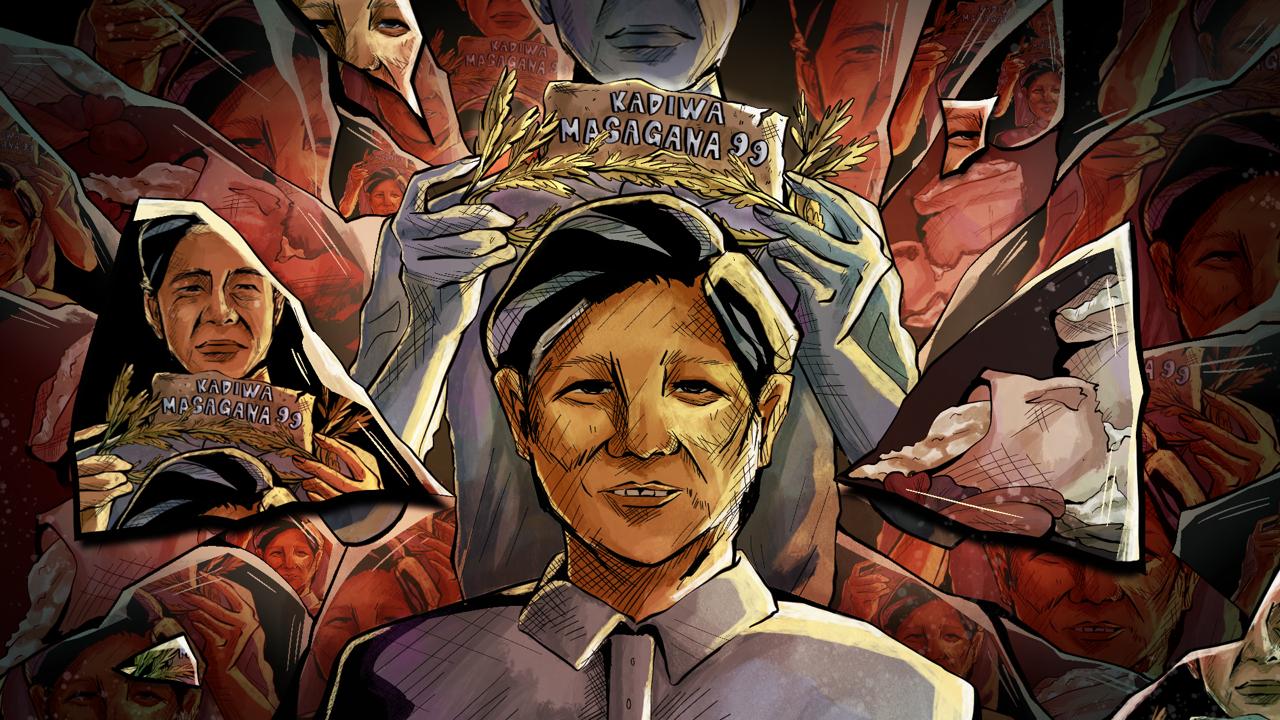
ECHOING HIS father’s image of an era of supposed self-sufficiency, Marcos Jr. feeds on the nostalgia of “food security” to confront today’s agricultural troubles. Yet behind this rhetoric lies weak safeguards for farmers, overreliance on imports, and policies that fail to take root.
This appeal to his father’s past governance comes as President Ferdinand “Bongbong” Marcos Jr. revives state-sponsored initiatives, which were first launched under his father’s tenure. He presents these projects as practical responses to the country’s economic strains and as part of a broader return to Marcos Sr.-era legacy policies.
Fabricated familiarity
The revival of programs that first emerged in the Marcos Sr. era became a defining feature in Marcos Jr.’s governance, intertwining policy with a calculated appeal to historical memory. Central to this approach are projects reminiscent of MASAGANA 99, which serve not only to address rising inflation, agricultural volatility, and food insecurity but also to reinforce a narrative of continuity in terms of his father’s legacy.
One such continuation is the KADIWA ng Pangulo, a Marcos Sr.-era program that pairs state-subsidized goods with high-profile distribution events to project a strong, interventionist government. The program operates through fixed outlets, pop-up stalls, and “Kadiwa on wheels” mobile markets that sell subsidized staples—rice, vegetables, fish, poultry, dairy, and other pantry items—at prices lower than private retailers.
This initiative is supported by direct government procurement of produce from farmers’ cooperatives, fisherfolk associations, and other accredited local groups, often carried out through negotiated procurement or community-participation modalities. Alongside this, the administration also set nationwide rice price ceilings of Php 43 per kilo for premium imported rice to offset fluctuations in agricultural prices.
While hailed as a “quick response to food insecurity,” these programs also function as political branding tools. Beneath their stated purpose, these initiatives serve to consolidate the Marcos name as synonymous with economic stewardship, setting the stage for a broader examination of state messaging in the current administration.
Gaps in the matrix
Behind the enthusiastic promises of MASAGANA and KADIWA lies the question of addressing critical food insecurity and the perennial challenges faced by the agriculture sector.
Magsasaka at Siyentipiko para sa Pag-unlad ng Agrikultura Luzon Regional Coordinator Rowena Buena argued that despite the existence of these projects, Philippine farmers still grapple with meager market rates in contrast to expensive farming inputs. Locally farmed crops struggle to compete against cheaper, tariff-free imported produce in the market, stemming from high production costs.
For the majority of the farmers, accessing KADIWA’s services also proves to be difficult as its satellite stores are located in regional centers—one of KADIWA’s initial drawbacks during Marcos Sr.’s presidency. Although the initiative aims to bridge producers and consumers directly, Buena noted that its reach is limited to a few partner farming communities, thus neglecting small-scale farmers.
These flaws compound the prevailing issues in the agricultural sector, namely, advanced land conversion, depleted arable lands, and the debilitating effects of climate change. According to Buena, these factors impede farmers’ ability to increase crop yield per hectare, as is the expected outcome of MASAGANA and the goal imposed by the Department of Agriculture.
“Ang hirap ngayon ilagay ‘yung kalagayan ng mga magsasaka kung may pag-unlad ba sila [dahil] nakikita [mong] hindi [sila] suportado (It’s difficult to see the development of our farmers when they are not supported),” she said.
In 2024, Marcos Jr. ordered the nationwide expansion of KADIWA in hopes of offering low-cost rice to more vulnerable communities. While the program has been launched in other parts of the country, University of the Philippines Department of Political Science Assistant Professor Nathaniel Candelaria, MA questioned its sustainability given its reliance on subsidies.
Candelaria also argued that other initiatives aimed at improving farming technologies could instead benefit from the money allotted to KADIWA. Recently, Marcos Jr. touted the government’s efforts to modernize the agricultural sector through processing and drying machinery and mobile soil laboratories—all to boost productivity and adapt to extreme climate conditions. Despite these plans, it remains that KADIWA and MASAGANA are ultimately ineffective in solving food insecurity in the country’s agricultural sector.
Building the future
To properly address food supply deficiencies, Candelaria suggests expanding alternative farming techniques, such as organic farming, designed with environmental protection in mind.
More than technological advancement, however, he emphasized the need to revisit the Rice Tariffication Law. Candelaria claims that, while the law has benefited consumers, it has ignored the predicament of farmers as a result of trade liberalization by removing tariffs on imported products. He likewise urged leaders to examine land reform policies, such as those involving land distribution to farmers.
Buena echoes these sentiments, asserting that persistent issues in the agricultural sector involve not only technical aspects but also socioeconomic dimensions. She highlights the concept of “food sovereignty,” as opposed to food security, when it comes to empowering farmers to produce sufficient and quality food supply for the nation. This framework considers the land area and quality of farming communities in tailoring programs according to their needs.
“Kasi kaya ng mga magsasaka natin [maabot ang production goals] kung mabigyan lang sila ng angkop na mga suporta, angkop na mga polisiya at mga programa (Our farmers can achieve production goals if they are given appropriate and adequate support, policies, and programs),” Buena emphasized.
While the younger Marcos attempts to emulate the same promises made by Marcos Sr. 50 years ago—a self-sufficient rice production and publicly available, affordable commodities—there remains a rift in the implementation of MASAGANA and KADIWA, regardless of how they are repackaged.
Realizing the ambitions of the Marcos Jr. administration demands a recalibration geared toward thoroughly investigated programs. As long as those who feed the nation receive ill-suited support, economic programs will remain temporary solutions—ones that reinstate the fragmented past of the old Marcos presidency.