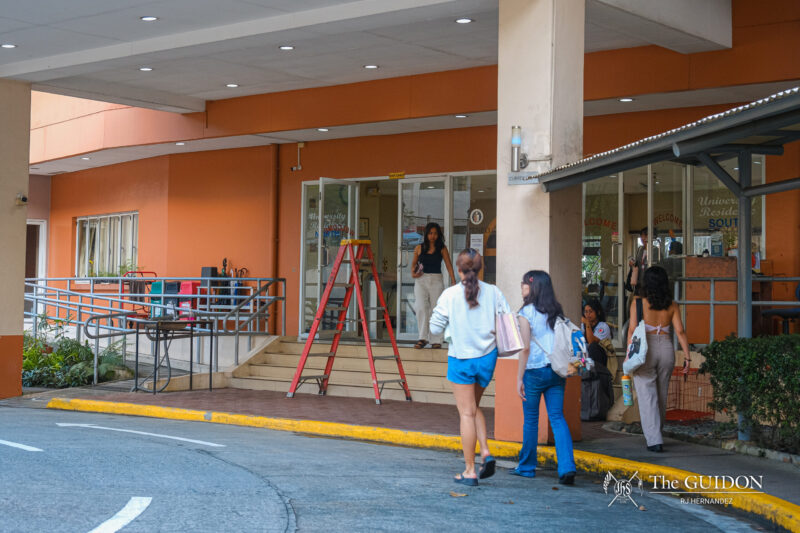
THE GONZAGA Cafeteria fully reopened both floors of the dining area last August 5, officially introducing Kitchen City and The Varda Group as its main concessionaires for the first and second floors, respectively.
With only a month to renovate their space, Kitchen City President Ricardo Abelardo Jr. shared that they focused on enhancing accessibility through a pick-up grocer and a renovated first-floor cafeteria interior. Meanwhile, The Varda Group Chief Executive Officer Christopher Guarin expressed his aim of improving the canteen experience through new facilities, dining options, and customer feedback systems.
Amid the renovations, Ateneo Scholars’ Sectoral Board (SSB) Representative Hxyll Almonguera raised student concerns, such as affordability due to rising food prices in the cafeteria.
First floor feasts
Elaborating on their vision, Abelardo shared that Kitchen City’s experience as the Basic Education unit’s main concessionaire gave them insight into customer preferences and expectations for an accessible and comfortable dining environment.
In particular, Abelardo stated that Kitchen City focused on consolidating food variety and pricing, as well as ensuring food safety standards. He also mentioned the idea of adding a Halal-certified food stall, but clarified that they are still searching for a qualified supplier.
For the first floor, Abelardo shared that they installed a pick-up grocer to purchase unplanned necessities on campus. Moreover, he noted that they prioritized improving the ventilation and lighting to enhance the students’ dining experience.
Building on these improvements, Abelardo said that Kitchen City is working with the University management to roll out a digital application for the college sector, which will serve as a feedback mechanism and an online menu catalogue.
In the long run, Abelardo added that Kitchen City aims to promote food safety in the Gonzaga cafeteria and provide students with access to essentials.
Gonzaga reimagined
With a similar goal of improving the campus dining experience, Guarin highlighted that the second floor of the Gonzaga cafeteria now features three main areas: the main food hall for everyday student meals, the “food salon” for diverse subconcessionaires, and Blue Café for collaboration and study.
“We don’t want to be identified as a low-budget cafeteria [or] a high-priced one […]. Everyone is welcome. That’s the range that we wanted to offer to the University,” Guarin explained.
To account for health and dietary needs, Guarin added that the second-floor cafeteria offers menus with calorie counts and allergen information. He also mentioned that The Varda Group is open to eventually becoming Halal-certified if the demand for it increases.
Apart from onsite facilities, Guarin shared that the concessionaire launched an online portal for borrowing dining materials, tracking reward points, and submitting feedback on menu variety, pricing, cleanliness, and other suggestions.
However, he stated that due to concerns over the website’s slow performance, The Varda Group temporarily removed the online utensil borrowing feature. Hence, the portal will remain active to serve as a feedback mechanism.
Moving forward, Guarin revealed that they are planning to add a distilled water fountain, bakery, and self-service salad and fruit station in the second-floor cafeteria.
In line with these developments, Guarin conveyed that their long-term goal is to provide a space where students can eat, study, and share ideas on campus.
Hot off the counter
With Gonzaga cafeteria’s reopening, Almonguera expressed appreciation for the area’s improved cleanliness, but raised concerns about affordability, transparency, and access to nutritious meals.
In particular, Almonguera said that the SSB conducted a services sign-up survey, which found that 40% of the scholar-respondents indicated that they were willing to spend Php 80 to Php 100 for their meals. With these findings, he urged the administration to lobby for policies that address student food pricing concerns.
Notably, Almonguera also specified that the lack of clearly posted prices in menu boards often left scholars off guard by their bills; hence, he recommends that the cafeteria consistently post price lists.
In further improving cafeteria protocols, Almonguera urged the University administration, such as the Office of Admission and Aid (OAA) and the University Business Affairs Office, to continue consultations and focus group discussions with scholars and the wider Ateneo community.
“[The SSB] urge[s] the administration and pertinent officers to involve the Scholars Sector and [the] Ateneo community when it comes to [what the University considers] as affordable food,” he asserted.
While the OAA consulted with both concessionaires regarding the distribution and use of scholars’ food stubs, Almonguera stressed that the concessionaires’ long-term performance will be determined by their consistency in providing food affordability and nutrition for the Ateneo community.