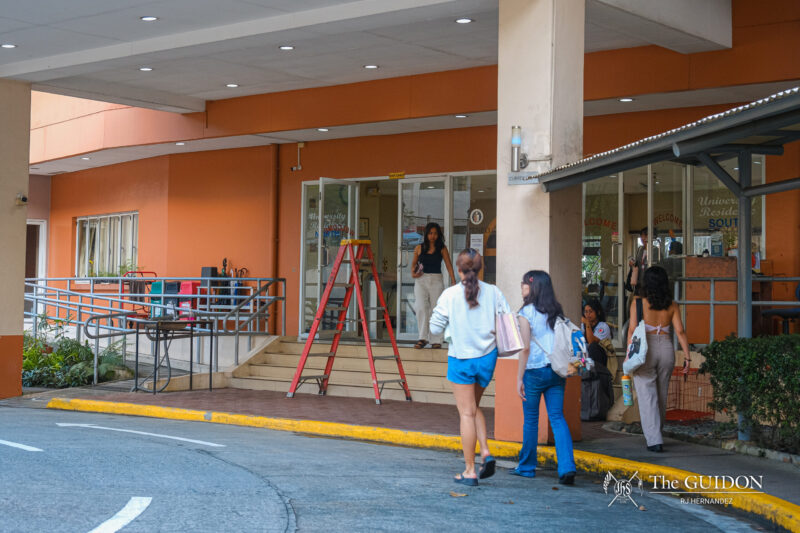
RENOVATIONS FOR the proposed five-story Matteo Ricci Hall have been ongoing since June 15, with the building closed until December 31. After the renovations, the study hall is expected to house three additional floors with five classrooms on each level.
In a meeting with incoming and outgoing undergraduate student leaders last May 5, Vice President for Administration Rodolfo Ang disclosed other details for Matteo Ricci Hall. He noted that some of the rooms may also be converted into laboratories or office spaces, depending on the decision of the Higher Education (HE) administration.
Apart from additional classrooms, Ang also revealed plans to place a drop-off point and an e-jeep stop directly in front of Matteo Ricci Hall.
Notably, the meeting was also attended by other administrators, including the Office of the Associate Dean for Student Affairs (OADSA) Campus Life Head Chris Castillo, MA, OADSA Student Concerns and Compliance Head Cholo Mallillin, and Assistant Vice President for Ignatian Leadership Formation Joy Salita.
Starting the building blocks
Expounding on the goal of the Matteo Ricci Hall expansion, Vice President for HE Maria Luz C. Vilches, PhD stated that the renovation aims to introduce more “flexible” classroom setups, in collaboration with the Campus Facilities Management Office (CFMO) and the Institute for the Science and Art of Learning and Teaching. To do this, the new classrooms will feature movable and rearrangeable tables and chairs along with “better technology-aided” facilities.
Meanwhile, CFMO Director Architect Michael M. Canlas mentioned that the study hall’s balcony will be refurbished, while the first two floors will be upgraded with new ceiling panels, lighting fixtures, and air-conditioning units.
With the renovation ongoing, Vilches announced in her June 11 memorandum that students can temporarily use the northeast wing of the Leong Hall Roofdeck, the School of Management Business Accelerator room located at the School of Management Building 402, and the PLDT-Convergent Technologies Center Building (CTC) 105 as study spaces.
In particular, CTC 105 will serve as the temporary location for the Sanggunian and Rizal Library’s semestral Matteo Up All Night initiative during finals week.
Following this, the Sanggunian released a public letter addressed to CFMO Campus Development and Construction Head Jelour. Casimiro, in hopes of better accommodating students during the closure of Matteo Ricci Hall. The suggestions included opening CTC 105 as a regular study area, using classrooms as additional learning spaces, and opening other areas for 24 hours during final examinations.
Shifting grounds
Prior to the start of the renovations, students had already expressed concerns about the availability of alternative learning spaces on campus, as Matteo Ricci Hall was expected to close for the intersession and the first semester of AY 2025–2026.
While former Sanggunian Vice President Iver John Delos Santos acknowledged the need for more classrooms, he also raised concerns over the timing of the renovations, noting that it would “severely disrupt student life” during midterm and final assessments.
Similarly, former Scholars’ Sectoral Board Representative Barbie Ortiz pointed out that closing Matteo Ricci Hall would further reduce the University’s already limited library capacity.
Former Ateneo Resident Students’ Association (ARSA) President Francheska Bugsangit echoed the same sentiments, highlighting that Matteo Ricci Hall’s second floor remains as one of the limited group study spaces available on campus.
With the limited availability of other work-friendly areas on campus, Bugsangit voiced her concerns that the closure could lead to overcrowding in the dorm areas as non-campus residents seek alternative spaces to study with their friends. She underscored that areas within the University Residence Halls are already often fully occupied, especially during the examination period.
“[At] the back of our [minds, ARSA] is worried because we want to fight for [the dormers’] spaces, especially since we pay [to use the facilities],” Bugsangit underscored.
To address this, she suggested creating multipurpose areas, such as conference rooms for group discussions and presentation practices. Bugsangit also expressed that students would no longer seek out off-campus spaces if sufficient study areas were already available within the University.
On the lack of study spaces, Ortiz shared that the Sanggunian conducted a survey last January 21 to gather suggestions addressing the lack of learning spaces on campus. Moreover, she proposed to extend the New and Old Rizal Library’s (ORL) operating hours and allow access to empty classrooms when there are no classes being held.
In relation to using the empty classrooms, Sanggunian Vice President Jedryc Romero raised the concern during the May 5 meeting that students are often asked to leave vacant classrooms if they do not have a formal reservation.
In response to this concern, Mallillin clarified that the guards clear classrooms past 6 PM for safety purposes. Nonetheless, Castillo assured that the administration can coordinate with security personnel to allow the possible usage of empty classrooms until 6 PM, even without prior reservation.
Searching for conducive spaces
To enhance student experiences within the HE, Ang stated that the University is prioritizing immediate needs before implementing other projects. As such, he mentioned that there are currently no plans to increase performance spaces for student organization activities.
Moving forward, Ortiz expressed that she hoped the administration would conduct surveys to consult “the main stakeholders” who use such facilities. Similarly, Bugsangit urged the administration to hold more consultations to listen to the lived experiences of the students.
Moreover, Delos Santos advised the administration to consider the concerns raised by the student representatives. Should proposed alternatives prove inadequate, he shared that the Sanggunian will “do [their] job” and advocate on behalf of the student body.
Subsequently, Delos Santos underscored the need for additional plans to mitigate the lack of study spaces within the University, emphasizing that it is the administration’s duty to find the best solutions.
Apart from Matteo Ricci Hall, Ang mentioned additional initiatives to address the lack of learning spaces, such as ORL renovations to centralize all research-oriented collections. He also touched on the construction of a new HE classroom building above the John Gokongwei School of Management Student Enterprise Center (JSEC).
Notably, Ang also gave a rundown of the administration’s major planned constructions until 2027, including renovations of the Northwest Carpark and the Social Sciences building, as well as plans to put up a new cafeteria at the New Rizal Library. He also shared that the Bellarmine Hall and Faber Hall will be repurposed into the Central administration and HE administration buildings, respectively.