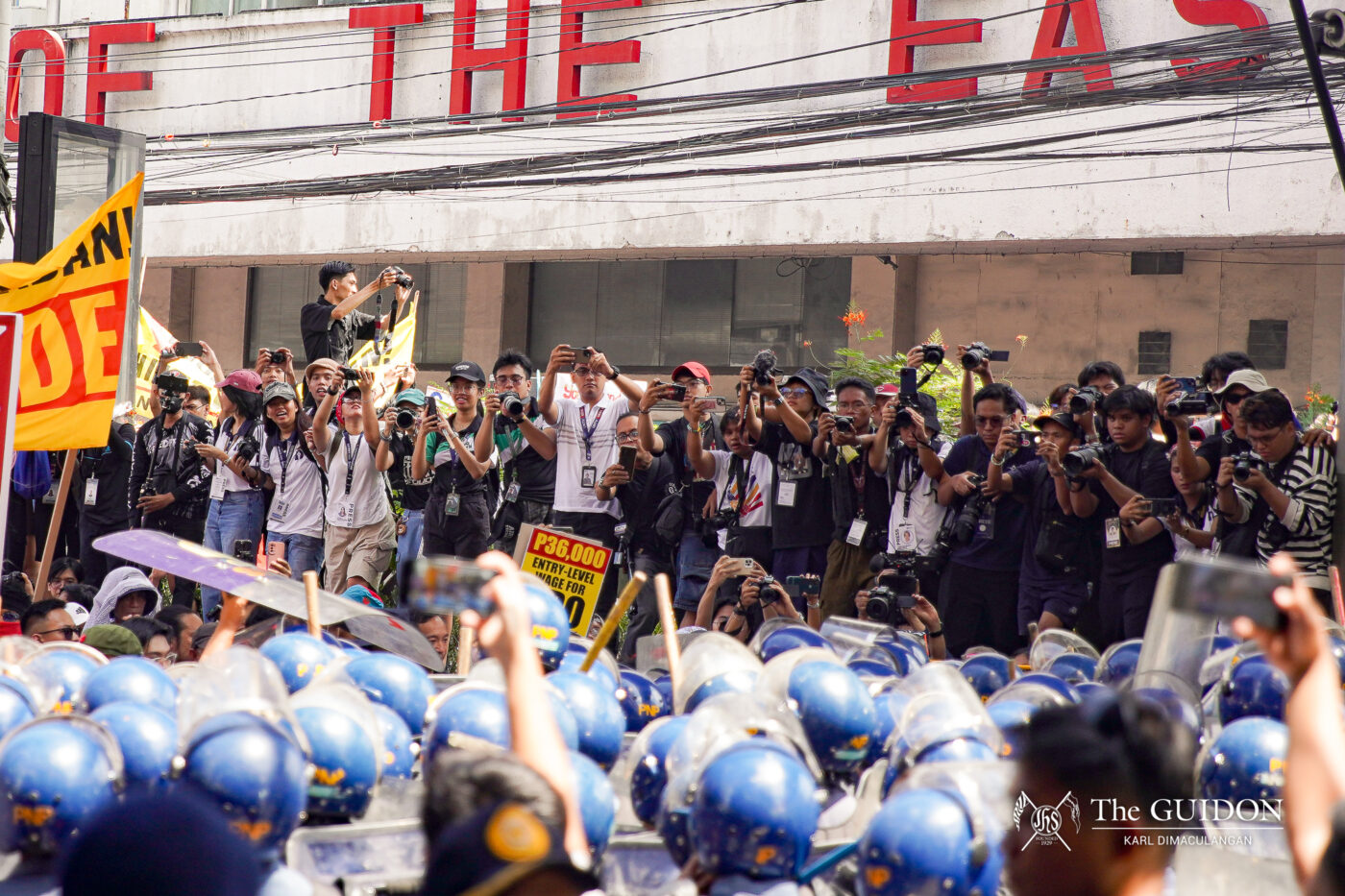
THE COMMISSION on Elections (COMELEC) and the Presidential Task Force on Media Security (PTFoMS) jointly recognize the need to protect journalists covering the 2025 National Midterm Elections. However, the recent increase in doxxing and online harassment targeting journalists highlight legal gaps, leaving them highly vulnerable to election-related violence.
Threats to the press
Forwarding the truth remains a life-threatening risk for journalists, as their freedom continues to be turned against them.
Such threats include red-tagging, wherein journalists are labeled as covert armed terrorists promoting communist propaganda under disguised rhetoric. Despite the Supreme Court’s description of the act as being a threat to one’s life, agency, and liberty, unjustified terrorist accusations have continued to rise throughout recent years.
According to a study conducted by the National Union of Journalists of the Philippines, 159 red-tagging cases were reported in 2024, encompassing both mainstream and alternative media. The study claimed that more than half of these incidents were state-sponsored—contrary to President Ferdinand Marcos Jr.’s statement that the threats do not come from the government.
College Editors Guild of the Philippines (CEGP) Spokesperson Brell Lacerna highlighted the severity of red-tagging in the country through the case of Frenchie Mae Cumpio, an investigative journalist detained in 2020 after being accused of financing terrorism and possessing illegal firearms. Before the accusation, Cumpio had faced several red-tagging attacks, prompting media outlets to protest the threats against press freedom.
The rise of such cases heightens the need to demand accountability and protection from attacks on press freedom. As such, Lacerna points out that administrative initiatives should take into account both local and international campaigns to safeguard press freedom.
“We want the fight for justice to be a fight for demanding accountability to our administration—especially the Marcos Jr. administration—for continuously protecting terror laws, taking it into effect, and targeting journalists, even at the campus press level,” Lacerna stressed.
Between duty and danger
In an effort to institutionalize media protection amid the volatile climate of electoral contests, an agreement between the PTFoMS and COMELEC was signed on July 23, 2024, officially categorizing acts of violence against media practitioners as “election offenses.”
Under the landmark initiative, any form of threat, harassment, illegal detention, red-tagging, or physical violence against journalists may be pursued under the Fair Election Act, the Omnibus Election Code, or the Revised Penal Code. The policy took effect in October 2024, coinciding with the filing of certificates of candidacy. The initiative will remain in force until June 11, 2025 when the winning candidates are sworn into office.
“The [Memorandum of Agreement] is the first of its kind between the COMELEC and the PTFoMS to address all violations on the right to life, liberty, and security of members of the press,” said PTFoMS Executive Director Undersecretary Paul Gutierrez in a press release last July 2024, highlighting the initiative’s significance amid rising attacks on journalists.
The agreement also establishes a direct reporting mechanism between the two agencies to ensure swift responses to election-related incidents. “I believe that the Memorandum of Agreement of COMELEC, the PTFoMS, is a step towards ensuring the lives of the press in its reportage, specifically in elections,” Lacerna reflects.
In an era where digital platforms have become battlegrounds for disinformation and intimidation, the dangers journalists face are no longer confined to the physical world. With that, Lacerna emphasized that more must be done to hold red-taggers accountable, including those who hide behind anonymity online.
Uncertain measures
Amid the agreement’s novelty, laws in the Philippines remain scarce in ensuring journalists’ security. As a result, reporters are impeded as they traverse dangerous local and national landscapes, where recurring threats of online harassment persist.
According to the France-based Reporters Without Borders (RSF), the Philippines ranks 134th out of 180 countries, two positions lower than the previous year, in the World Press Freedom Index 2024. Although fewer and less violent attacks were reported, RSF asserts that the Philippine situation remains worrisome due to persisting threats and red-tagging.
The most recent Philippine law regarding journalist security is Republic Act No. 11458, or the Shield Law, which broadens the scope of protection to include all media practitioners, such as those in organized print, broadcast, and online media. This law exempts journalists from being compelled to reveal their confidential sources to government institutions, unless deemed necessary for state security.
For student journalists, the Campus Journalism Act of 1991 remains the only existing national law which safeguards and promotes campus press freedom. Lacerna asserts that the law is outdated, weak, and often weaponized against student journalists, especially when reporting on electoral-related issues.
“The only way that journalists protect themselves is through unions, safety guides, and training mostly [within] media practitioners,” Lacerna claims.
Regarding necessary reforms, Lacerna also emphasized that the administration must listen to mobilized media efforts, such as intensified campaigns of press freedom, to concretely implement laws concerned with journalist security.
In hindsight, the midterm election presents just one example of the systemic vulnerabilities presently exposing journalists to risks. However, these vulnerabilities exist even outside the election season and grow more dangerous during it.
Despite the perennial challenges faced by those in pursuit of responsible reportage, beneath its stakes lie reporters’ duties to uncover the truth—values that push journalists to navigate both physical and digital landscapes to ensure that stories live on.