ETHNOLINGUISTIC IDENTITY remains a prominent social division in determining political behavior in the Philippines, most especially in one’s exercise of suffrage during the elections.
Historically, candidates have been known to win in their bailiwicks, as evidenced by the 1949 presidential race when Elpidio Quirino secured the Ilocos vote. Meanwhile, Ferdinand Marcos Jr. produced a potent coalition of supporters from the North and South, consolidating the “Solid North” and “Solid South” narratives in the 2022 elections.
As the 2025 Midterm Election approaches, Ateneans—alongside millions of Filipinos—prepare to cast votes for over 18,000 public posts. While students from different Jesuit higher education institutions share the same Ignatian education, trends from previous elections reveal that political stances can ultimately be shaped by distinct regional contexts.
Ignatian ideologies
With a weak and incoherent party system, Philippine politics is predominantly driven by personality and patronage rather than political ideology. Candidates tend to attain landslide victories in their bailiwicks, such as when Sara Duterte secured 95.6 percent of the votes in Davao City during the 2022 vice presidential race.
This polarization is evident in Davao’s political landscape. During the Halalan 2022, fourth-year Political Science student Jhoanna Grace Cayanan of the Ateneo de Davao University (AdDU) recalls how the political views of her peers and family closely aligned with their region’s dominant preferences.
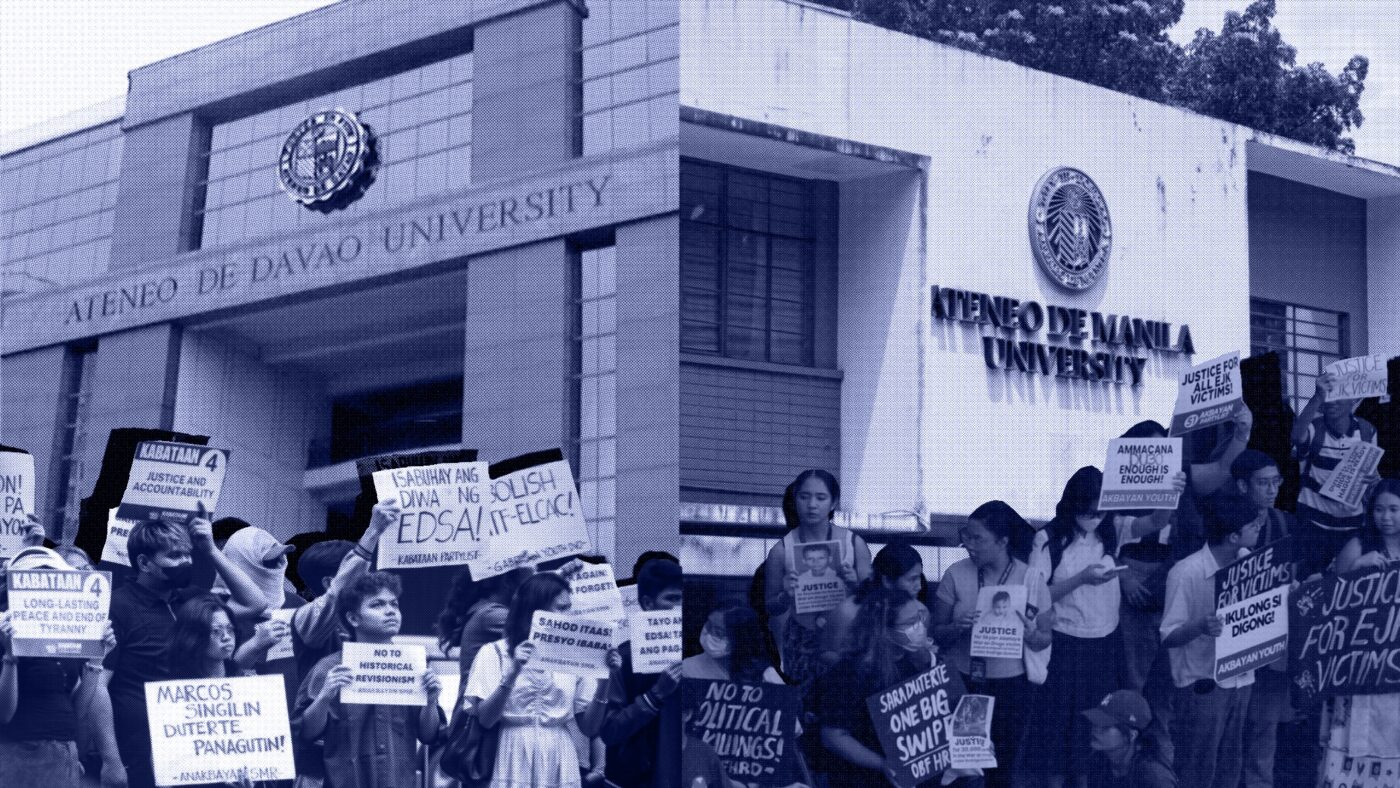
Due to this regional consensus, people were unwilling to consider other options, leading Cayanan to become hesitant in voicing her political opinions for fear of being ostracized. Such behavior became apparent when the Ateneo Publications Alliance published a statement last March in support of the International Criminal Court’s arrest of former president Rodrigo Duterte.
While other Ateneo student publications received little to no backlash, AdDU’s student publication Atenews faced criticism from alumni who claimed that the publication’s stance did not reflect the sentiments of the AdDU community.
With constant discussions on politics from a population solely bent on a specific politician, being part of the minority may cause one to reevaluate their option. Cayanan explains that popular beliefs and regional consensus are continuously reinforced, leading those who deviate from the “loud majority” to reconsider their stances.
In such cases, Cayanan emphasizes that institutions play a big role in transcending echo chambers that confine the electorate to vote for familiar and proximate candidates. In particular, she underscores that Ignatian values help students break away from reinforced beliefs and assess things more objectively.
Likewise, AdDU Political Science and History Department Chair Rhodalie O. Emilio stated that the Ignatian value of discernment encourages students to evaluate their political beliefs through critical thinking and discussions.
While her Ignatian education helped sharpen her political consciousness, Cayanan says that it was not the “turning point.” As Emilio explained, lived experiences and the local populist political culture “bled into” the political values of the University.
Ingrained experiences
Ethnic or regional association alone is not the primary driver of identity-based voting. Instead, it is reflective of a deeper issue on the ground—the economic grievances and lived experiences of regions marginalized from national development.
Cayanan notes how Mindanao has always been “sidestepped” in national development. This exclusion is why Cayanan believes Duterte won the 2016 presidential elections, as his association with Davao gave Mindanao long-awaited representation.
With this, Cayanan points out that people tend to “overlook” the wrongs politicians do as long as they believe that the politicians are making a difference to Davao City’s development.
This dynamic results in a culture of “patronage politics” or “clientelism.” Emilio describes this phenomenon as the tendency to vote for the candidates that look after people’s interests, paying off their debt of gratitude or utang na loob.
She also recognizes that Philippine political beliefs are rooted in loyalty, as Filipino society values kinship relationships. Hence, voters tend to gravitate to populist and personalistic candidates whom they perceive to embody their interests.
Cayanan echoes this belief, underscoring that people tend to opt for candidates who are more familiar and proximate to them, believing that any gains will benefit them directly. “We [in Mindanao] have been sidestepped for so long that if we see someone being a ‘beacon of hope,’ then we see that person as an end-all, be-all,” she stresses.
Expanding on this idea, Political Science professor Anne Lan K. Candelaria, PhD highlighted how one’s definitions and perspectives on concepts such as “better lives” are dependent on one’s context and location.
However, Cayanan stresses that this mindset should not be dismissed as ignorance. Rather, it reflects the people’s experience of being neglected in national agendas.
Inclusive representation
Given the varying lived experiences of Filipinos, their perceptions of national identity remain unclear due to disparities in regional representation within the national government.
“If you feel that you are being neglected by the national government, you may still identify as Filipino, but that sense of national pride might not be as strong as that sense of regional pride,” Emilio emphasizes.
This is the case for Cayanan who identifies more with her region rather than her national identity as a Filipino. She explains that the meaning of words like “nationalism” feel more like an “abstract concept,” making these difficult to identify with.
While differences in lived experiences and geographic contexts amount to varied political beliefs, Candelaria notes how genuine representation and nationalism are still within reach. “It’s so difficult to find meaning as a country given our diverse situation, but it’s not impossible; it’s just more complex compared to other countries,” she stressed.
To ensure that the dividends of national development will reach the most distant regions, Emilio asserts that electing high officials from Mindanao is not enough. “I do not think that one president will be able to overturn decades of neglect by the capital on the development of Mindanao. […] Much has yet to be done to equalize the gap between Mindanao and the capital and the Visayas,” she expounds.
Amid this neglect, Emilio believes that the national government should also give more attention to other regions in Mindanao aside from Davao and deliver equitable public service to the people. In addition, Cayanan underscores the need for sectoral representation, particularly for indigenous communities in Mindanao.
Meanwhile, Candelaria adds that inclusive representation requires strengthened coordination across local government units and public trust in democratic institutions. “Once that [trust] is built across regions, then you can actually now begin a genuine conversation,” she states.
Such trust, Candelaria highlights, allows people to conceive individual injustices as collective ones, paving the way for inclusive nation-building.
As the midterm elections inch closer, bridging disparities in political representation becomes dependent on the political will of leaders to weave together all regions into the national development framework.