Civic duty mostly comes in the form of casting ballots, but for teachers, it is also in the different ways they take charge of the classroom.
THE FUTURE of our nation is shaped in the classroom.
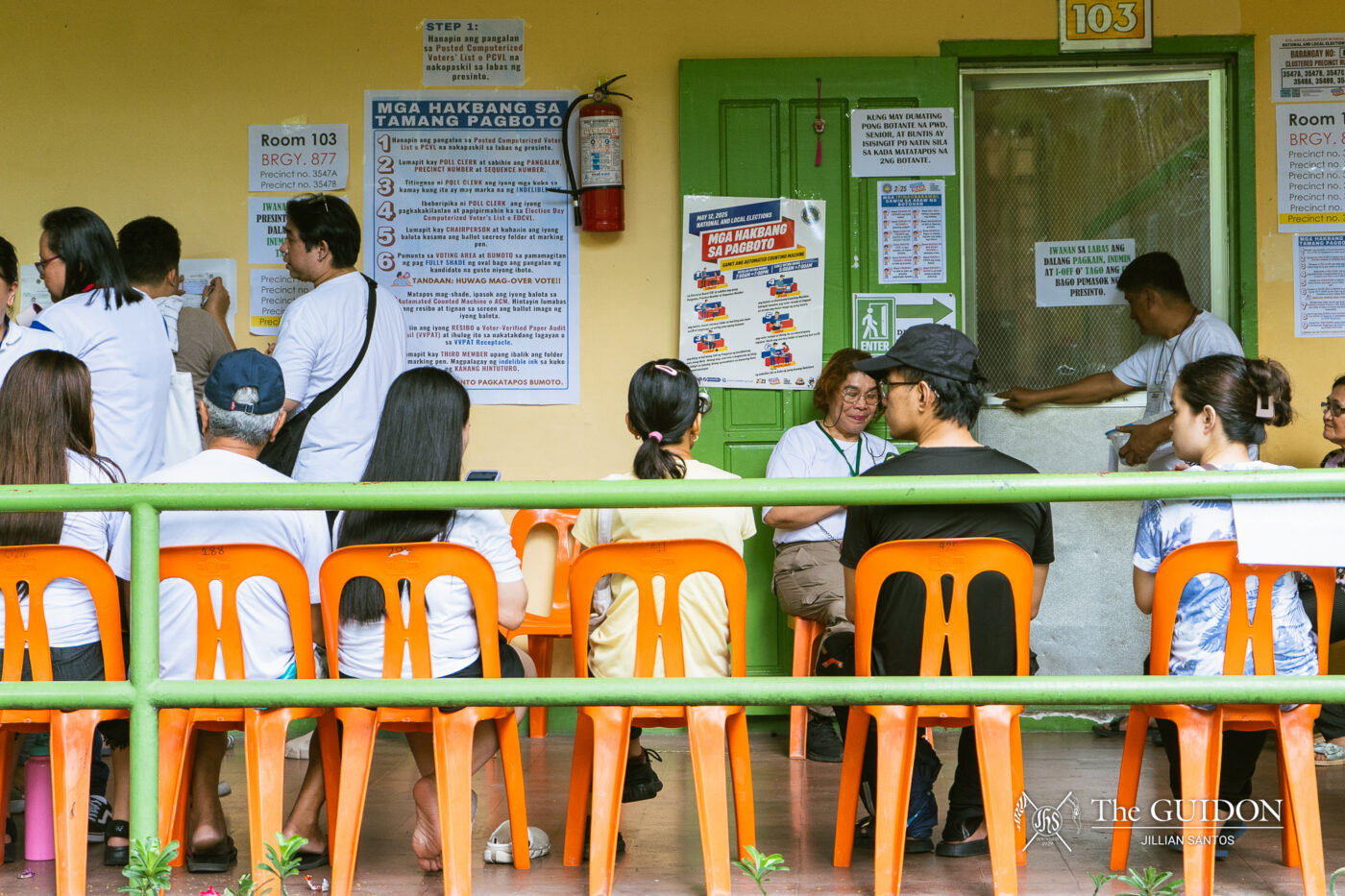
As students file into the classroom to learn, teachers help them understand the world and their personal place in it. On election day, however, these very same sites transform into polling precincts, calling teachers to become poll watchers as voters arrive in place of students.
Guiding both prospective and current voters, educators stand as the often-overlooked frontline of democracy, occupying the same space where the future is formed.
Yesterday’s dream
Ma’am Noemi Bunquin is a 49-year-old educator, wife, and mother, whose childhood playtime blossomed into a 26-year career of shaping young minds. Apart from being a subject teacher who handled students from kindergarten to the third grade, she also assists the principal with administrative tasks while previously mentoring Girl Scouts.
While juggling these roles, her greatest delight is seeing her students succeed. “[Pinakamasarap sa pakiramdam] ‘yung nakapagpaturo ka nang batang makabasa, makasulat… pinaka-achievement mo sa buong taon (The greatest achievement of the year for me was to have helped my students read and write.)” she says.
Her work with children and superiors alike, coupled with her colleagues’ encouragement, eventually motivated her to apply for a higher position. Her efforts paid off when she became one of their school’s head teachers, tasked to train fellow educators and collaborate with other stakeholders to improve education quality. These actions hold greater weight as she co-leads a school for indigenous students, where Mangyan children are among its population.
While Ma’am Bunquin brings decades of experience to her role, a younger yet equally driven educator—just 27 years old—recounts his own path of purpose.
Sir Jefferson Barrocamo spends the workweek teaching his high school students Araling Panlipunan, Social Sciences, and Contemporary Arts from the Regions—all while working toward his master’s degree in Philippine Studies.
As someone on a continuous path of gathering and imparting knowledge, he finds fulfillment in seeing the sparkle in his students’ eyes when they start to understand the discussion.
As Ma’am Bunquin and Sir Barrocamo work to instill valuable lessons in their students, their dedication goes beyond classrooms.
What today demands
While highlighting the role of educators in honing their students’ academic capabilities, Ma’am Bunquin also underscores the need to build up their confidence. “Lagi kong sinasabi sa mga guro na iparamdaman niyo sa mga bata na kabilang din [sila]. […] Huwag niyo iparamdam sa mga bata na dahil sila ay IP, sila ay behind.”
(I always tell the teachers to make their students feel like they belong. Don’t let them feel like they are behind just because they are indigenous people.)
Similarly, Sir Barrocamo shares his signature butil-karunungan (grains of wisdom)—a self-composed verse—with his students to wrap up his lessons, which helps bridge classroom knowledge and universal values.
The time and energy both teachers give for their students is also palpable on election days, when they can both be seen at the polls. Although the Election Service Reform Act allows public school teachers to decline poll duties, Ma’am Bunquin performs them proudly, acting as a Department of Education Supervisor Official. With her position, she monitors the preparation of the precincts and ensures the readiness of teachers who will serve on the electoral board.
On the contrary, Sir Barrocamo—as a private school teacher—shows up as a form of personal advocacy during election day, as he is not obligated to work at the precinct. Volunteering as a poll watcher under the Parish Pastoral Council for Responsible Voting (PPCRV), he watches out for anomalies, then stays after the polls close to accompany the election officers and help secure the documents needed for the PPCRV’s independent tally of votes.
“As a social science teacher, it is a call to participate,” he says, emphasizing the concept of participative democracy he instills in his students. Apart from his social duty, he also believes that helping in the elections is his moral duty.
Through the night
The obligations as poll workers ring true even when the path is far from comfortable. For Sir Barrocamo, national elections in his corner of Quezon City are always marked by howling dogs in their neighborhood—a sign that “strangers are roaming the neighborhood, handing out sample ballots.”
In Puerto Galera, meanwhile, Ma’am Bunquin feels the same sense of tension. She shares an instance when her fear intensified after poll workers like her were once asked to keep ballot boxes in their own homes. Despite her apprehensions, she had no choice but to turn her sanctuary into a potential target, posing a real threat to her family’s safety.
Come morning, Sir Barrocamo and Ma’am Bunquin report to their respective precincts for duty—not because the tension has passed, but because duty calls nonetheless. Whether guiding voters or guarding the process, they remain as sharp as ever.
In Ma’am Bunquin’s area, elections appear quiet on the surface—yet an invisible, unspoken threat continues to loom. Teachers are strictly prohibited from discussing political affiliations with their community, as doing so can constitute an election offense. She shares that this practice of silence also extends far beyond election season and into the privacy of their faculties.
“Ang politiko, kapag ‘yan ay nakarinig ng negative…may kasunod na ‘di mo alam kung anong gagawin sayo. Dapat laging safe ka dahil […] gagawan at gagawan ka nila ng kuwento na baka makaapekto sayo,” she explains.
(When a politician hears something negative, you never know what could happen next. You always have to play it safe, because once those in power hear something, they’ll start making up stories that could affect you.)
This caution reflects the broader anxieties surrounding the country’s electoral system, where silence does not always mean peace. Still, for ordinary citizens, such silence is a necessary act of self-preservation when speaking out can come at a cost.
When dawn breaks
Once the last vote is counted, the public awaits the results, but for volunteers, it is only then when exhaustion and a sense of finality can begin to settle. Recalling his experience during the 2022 elections, Sir Barrocamo shares that the feeling was not just fatigue—it was a quiet grief, because even before the final tally, he had already sensed the outcome.
Regardless of every election’s result, the two return to their primary calling: to help their students grow. Sir Barrocamo believes that as the youth remain the hope of our future, teachers, in turn, are the hope of the youth.
For Ma’am Bunquin, on the other hand, embodying that hope means helping Indigenous students flourish, so they are better-equipped to navigate a society where the vulnerable and underrepresented are often targeted.
“Lagi namin (co-teachers) sinasabi sa [mga students namin] na maki-join [sa socio-political discussions], at [sabihin] kung ano ang nararamdaman niyo. ‘Wag kayo magpapaloko,” she expresses.
(We co-teachers always tell the students to join socio-political discussions and express what they feel. Don’t let yourselves be fooled.)
The end of election day does not mark the end of duty for teachers. As their students— who are ever eager to learn—return to their seats, the weight of democracy shifts back and the classroom-turned-precincts become theirs again.
Ultimately, in a country where the lack of education is weaponized by those in power, teachers stand at the frontline. Educators dedicate themselves to building a more informed, compassionate society—one lesson, one student, and one election at a time.