In the Ateneo, volunteerism and activism are treated as divorced concepts. The residual effects of the organized front against inequality and oppression that flourished during Martial Law and the down from the hill movement have manifested as attendance in required immersions and registration for sector-based organizations during Rec Week.
Indeed, many Ateneans would brand themselves as volunteers, but not as activists. There is a general perception of volunteerism as altruistic and generous and activism as disruptive and violent. However, these ideas are strongly misleading. Volunteerism can be harmful, and volunteers can also be self-serving. It can nurture dependency on the community and remove the community from the development of interventions, resulting in the community’s short-term relief and long-term stagnation—or even debilitation. In the Ateneo, for instance, many organizations provide opportunities to make impoverished youth happy for a day.
While this is a noble venture, it does not address the underlying circumstances at hand: What happens after that one day of happiness in a year? Why are they unhappy in the first place? How is their poverty alleviated?
Contrarily, while activism does seek to disturb the status quo, it is not monolithic by definition. In this country, it is mainstream media and the government that have portrayed activism as violent, when in fact, it is not necessarily violent—only becoming so due to police and military instigation. Especially in these past few years, when red-tagging has become prevalent among universities, Ateneans are enculturated to avoid activism, lest they paint red targets on their backs.
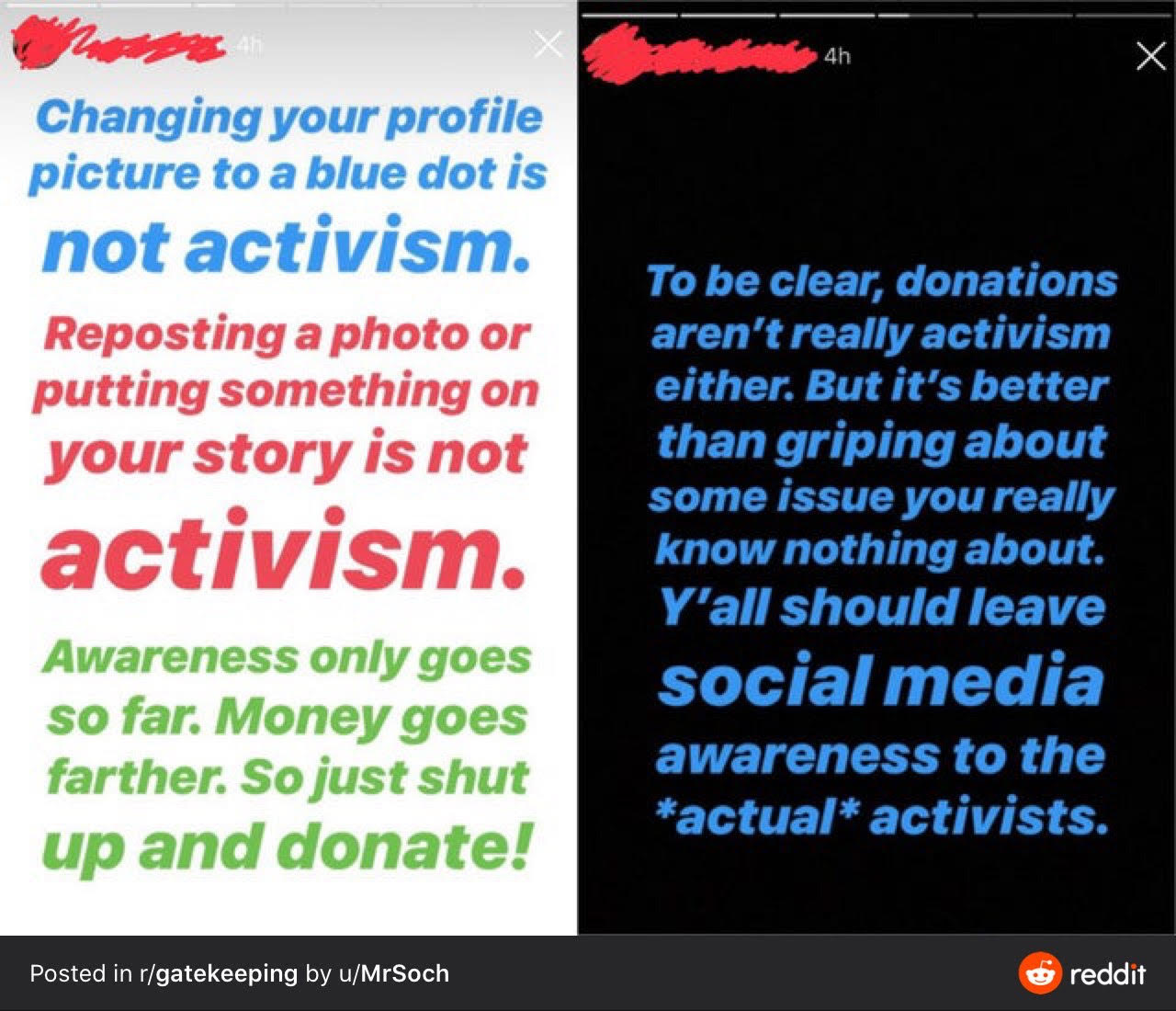
It should be noted, though, that there are other factors contributing to the widespread disenchantment towards activism—one of these being the gatekeeping of activism. Activists have, in fact, coined the term “slacktivism” to refer to actions that are discerned to be unhelpful to the cause. Indeed, activism goes beyond being the first to the picket line, entailing difficult conversations that cannot be covered by a few minutes of introduction and photo-taking. But while it is valid and vital to confront performative activism, it should be addressed that gatekeeping has also been harmful to the very objectives of social involvement and political participation. If we keep alienating people who might care, who are left to be our allies? How will we achieve the results we need, without them?
Interestingly, in the Ateneo, those engaging in community service are not the same ones taking part in mobilizations, and those arranging statements are not the same ones immersing themselves in the grassroots. While some Ateneans do practice both volunteerism and activism, they are the exception and not the norm. This disjuncture is counterproductive; social involvement projects must always be accompanied by systemic action, while activist movements must always be founded on on-the-ground relationships and experiences.
Even as Ateneans organize fundraising events, there is a prominently low turnout in Gate 2.5 protests. Even as Ateneans attend leadership seminars, there is a remarkably low murmur surrounding issues in labor, agriculture, and indigenous rights. Some are quick to plead the red-tagging rationale, feeding the fear that prevents social involvement and political participation from conjointly thriving in the University in the first place. This begs the questions: Who do we really care about? How can we care more effectively?
Ideally, volunteerism and activism are married, coming hand in hand to effect genuine solutions to world problems. Without one, the other stays uncatalyzed, the process incomplete, and the goal unrealized. For as long as the Ateneo continues to perpetuate the conditions that lead to this disunion, it remains an aspiration that the line between volunteerism and activism ceases to exist.
Angela Maree Encomienda is an AB social sciences major and the founder and chairperson of The Initiative PH. She may be reached at eangelamaree@gmail.com or 09399193208.