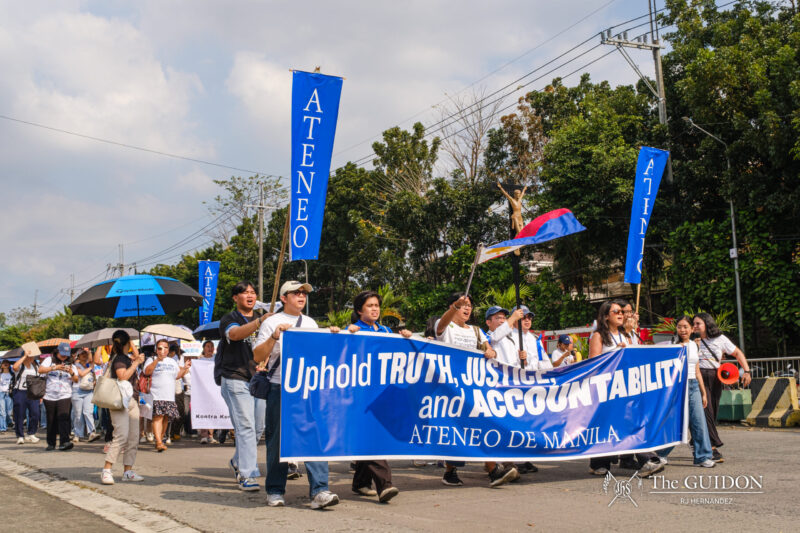
SIMBAHANG LINGKOD ng Bayan-Task Force Anti-APECO (SLB-TFAA) National Coordinator Jhana Ligue believes that students have a “vital participation” when it comes to social movements in the Philippines.
Ligue said that she has proven this through the active participation of Ateneans from the beginning of the Anti-APECO campaign.
SLB is the socio-political apostolate of the Society of Jesus in the Philippines. SLB serves as the secretariat of the whole TFAA network.
The Aurora Pacific Economic Zone and Freeport (APECO), an extended version of the Aurora Special Economic Zone, aims to convert 12,923 hectares of Casiguran, Aurora into a commercial, residential, and industrial complex. The project has displaced farmers, fisherfolks, and indigenous people residing in the area.
In December 2012, the Ateneo welcomed 124 Casiguran locals on the 18th day of their 370-kilometer march to the Malacañang Palace, in an effort to implore President Benigno Aquino III to hold the budget for APECO.
In an interview with The GUIDON, Ateneo Task Force Anti-APECO (ATFAA) Head Bianca Santos said that being aware of the issue is different from witnessing the plight and hearing the stories of the affected residents firsthand.
Santos said, “The march happened four years ago, meaning, the people who got to see them are the seniors right now. Since we are graduating, we want to keep the solidarity of Ateneo with the locals of Casiguran.”
Upholding solidarity
Recently, the ATFAA organized an immersion program in Casiguran on March 21 to 23, as part of the group’s agenda to encourage more Ateneans to take part in the campaign.
ATFAA has also previously called for donations and has held fundraising activities such as selling shirts and keychains to aid in the rehabilitation of the livelihood of the locals after Typhoon Lando struck the area in October 2015.
Santos said that they were able to purchase a boat for the residents of Barangay Dibet with the amount they have accumulated.
Moreover, ATFAA partnered with the Christian Union for Socialist and Democratic Advancement, Ateneans for Agrarian Reform, and Alliance of Laborers and the Youth for a two week-campaign on March 1 to 11 to forward rural development and labor issues, such as APECO, in the discourse of the upcoming national elections.
Santos noted that during the “Ang Kailangang Boses Senatorial Forum” organized by SLB, there was a special segment on the APECO. However, she was not satisfied with the responses of the senatorial candidates which were mainly “motherhood statements.”
“Ang Kailangang Boses Senatorial Forum” was held at the Henry Lee Irwin Theatre on March 14. The format allowed a dialogue among the senatorial candidates and the marginalized and vulnerable sectors in the country.
ATFAA, however, is currently focusing on transitioning the organization for the next academic year. As of writing, a list of its new officers is not yet available.
“We have around five to six people handling the operations. We also have around 30 members working in the core team. The number is just right because we do not want a lot of work to be dispersed since we are waiting for SLB’s mandate,” Santos said.
She added, “SLB is very strong and we work closely all the time. Since SLB is holding the nationwide campaign, I’m not scared that the efforts will not be sustained.”
On a national scale
Aside from the Ateneo, Ligue said that SLB-TFAA is also trying to reach other colleges and universities in Metro Manila such as Miriam College, St. Scholastica’s College Manila, Adamson University, and the University of the Philippines-Diliman to expand the support group for the Anti-APECO campaign.
She added, “SLB-TFAA has contacted schools mainly in Metro Manila because further from the capital, active participation cannot be assured. Like in Mindanao, they are also facing challenges that are being neglected.”
According to her, APECO is a national issue that is “glaring,” but is being neglected such that there is an “aggression” happening to the Casiguran locals who were not consulted and are expected to adapt to the changes forced upon them.
SLB-TFAA aims to block the release of the APECO budget for 2017, demand a comprehensive report from the Commission of Audit on the budget spending through the years, and push for genuine agrarian reform.
But ultimately, SLB-TFAA and ATFAA seek for the APECO law to be repealed.
Similarly, Anti-APECO advocate Hansley Juliano says that the ideal would be scrapping and repealing the APECO law because it is the “institutional tool that allows land appropriation and conversion” at the expense of the locals.
Juliano praises the Anti-APECO campaigns by SLB-TFAA and ATFAA because he sees that they are “easy to activate” whenever there is a necessity to talk about the issue.
“The campaign is actually doing fine. The APECO issue will not hog the headlines all the time, but the fact that we have these people, it definitely means something,” he said.
He added, “If people are beginning to care about the Kidapawan issue, if they care about the sufferings all over the world, why would they not care about the one in Luzon? Probably the only reason we don’t care that much is because, so far, nobody has died yet. But this issue is part and parcel of the decades-long agrarian problem confronting the Philippines.”
Protests in Kidapawan were brought about by the El Niño-induced drought and the alleged non-compliance of the local government to provide rice to the farmers with dwindling crops and income. Three farmers were killed and many were wounded after the Philippine National Police attempted to disperse the crowd and clear the highway.
Juliano said that the upland farmers in Casiguran just won in 2015, after five years into the campaign, but he sees that the remaining victories may come longer.
The road ahead
Ligue believes that the fight against APECO is still a long way from conclusion, but she hopes that those participating in the campaign, especially the Ateneans, will continue their “unwavering dedication.”
She said, “APECO is the amalgamation of the environmental, political, and economic problems right now in the Philippines. It is not questionable, for me, kung tama pa ba ang pinaglalaban natin (APECO is the amalgamation of the environmental, political, and economic problems right now in the Philippines. It is not questionable, for me, if what we are fighting for is right).”
Santos explained that the support of Ateneo for the Anti-APECO campaign encouraged more people to listen to the stories of the locals and connect with the network of Anti-APECO groups.
She said, “It is important that we recognize this privilege and it is also important [that we] do something about it.”