It’s hard to go against the current of everyday life. There’s too much stability and certainty, especially within the walls of the university where days are scheduled down to the minute.
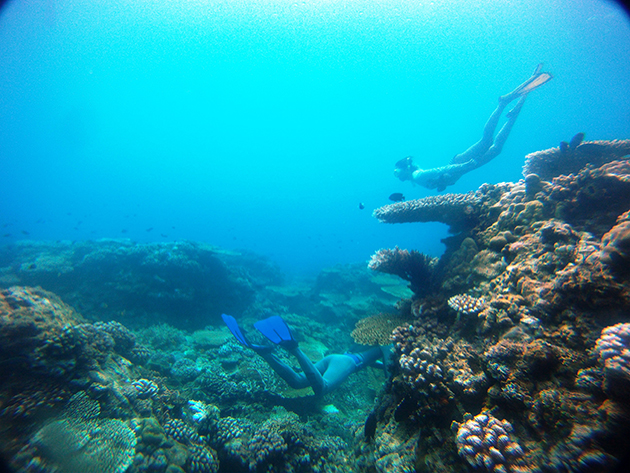
But every now and then, a distant tide rushes in without a warning, breaking the monotony. At present, that momentous and fast approaching tide is the active, adventurous community of the Institute of Skin Divers Ateneo (ISDA). An unaccredited organization, its members dive in the open seas armed only with a mask and a pair of fins.
The flourishing community is opening its ports to diving enthusiasts, marine advocates and anyone who’s interested in giving skindiving a go.
New currents
ISDA didn’t spring right out of the tides. The organization was the brainchild of Gela Petines (BS ES ‘11) during her senior year. “Initially, [what inspired me] was simply the sea. I had a passion for exploring and learning about marine life,” she recalls.
As Petines studied various coral reefs and marine life for her undergrad thesis, her appreciation for the ocean grew. This led to her interest in diving. Eventually, her dreams of starting up a scuba diving organization in the Ateneo surfaced.
However, Petines hit her first snag when scuba equipment turned out to be too costly for students. This led her mother, a former University of the Philippines (UP) Divers member, to suggest a cheaper alternative: skindiving.
Soon, word of the organization reached Rey Niño Baguio (BS PS-CE ’05) and Ian Tabangay (BS CS ’02), both members of the Ateneo’s Loyola Mountaineers and the UP Marine Biological Society. The two offered their support and dedication to Petines’ vision, urging her to follow through with her plans. “I think that’s all the push I needed; to be believed in,” Petines admits.
Petines also acknowledges how ISDA would have stayed a dream without the devotion of her other cofounders, Luke Imbong (BS Psy ’12), Glenn Barit (BS MIS ’12), Zhiela Santillan (BS Mgt ’15), Dondi de Mesa (AB MEco ’12) and Jenica Dizon (BFA ID ’13). “To be honest, I wouldn’t have pushed this far if these guys didn’t join me. Sila talaga yung rason kung bakit may ISDA (They’re really the reason that ISDA exists).”
Since then, ISDA hasn’t had any major problems with regard to public interest, as it has attracted several Ateneans through word of mouth and online media.
They faced their fair share of difficulties, however, when it came to laying down foundations such as organizational rules and structures. The org heads have yet to establish a set of distinct skindiving rules, which are crucial considering they’re dealing with a sort of diving that not many people are familiar with. “What we follow are the safety protocols of scuba diving, tweaked a little bit into skindiving,” explains AJ Villar (AB IS ’06), the current president of ISDA.
Today, ISDA continues to thrive on the ideals that inspired Petines: Her love for the ocean and sharing this interest with other people. Though it’s still pushing for accreditation with the Office of Student Affairs and is still run by graduates, ISDA continues to grow.
“It’s difficult, but we’re getting there,” says Villar, regarding their journey to accreditation.
Seek or swim
Aside from adventure, ISDA also offers firsthand learning. Part of the org’s role is to offer marine skills training and instruction, which are essential to making the most out of any dive.
The org’s most common dive is the open dive, which, as the name suggests, welcomes anyone who’s interested. During these dives, ISDA’s official members fill the newbies in on the basics. This training system has turned many a beginner into a natural diver. “I was scared of the water before starting [with] ISDA,” admits Villar, who had no diving experience prior to joining the community.
ISDA also offers training dives at sites like Anilao and Lobo in Batangas, in order to sharpen current members’ skills. These locations, with their slower currents and vast array of pristine marine life, are ideal for training. More advanced members, on the other hand, venture into rougher waters, such as Batangas’ Isla Verde Passage, during their exploratory dives.
“What’s unique about ISDA is that we value quality among our members in terms of skill in skindiving, especially safety,” says Petines. Whether members are going to be taking on a shallow training dive site or Isla Verde with its “insane currents,” ISDA’s founders make it a point to include first aid training in the application process.
Baguio and Tabangay, scuba divers themselves before the community started, handed down their technical skills to the ISDA pioneers. Equalization for example, is a method that balances the pressure around the diver’s ears when reaching new depths.
“[Baguio and Tabangay] are responsible for the fact that I can now dive up to 40 feet,” admits Petines, thankful for their dedication and instruction. Usually, beginners can barely reach 30 feet. At present, several other ISDA members can dive down to 60 or 75 feet.
Nature, nurture
If there’s any uncertainty in the waters, it’s in what the future will bring. For a country teeming with marine life, the Philippines seas are hardly protected by the country’s people, in spite of laws that have been enacted in the previous years.
ISDA responds to this reality by giving an active sense of responsibility to their dives: Every dive is a cleanup dive. To keep the provincial communities clean, divers pick up whatever trash they find in their dive sites and bring them back to Manila.
“It’s a good start,” comments Biology Department instructor and marine biology expert Ronald Cruz. However, he adds that that for this practice to be sustainable, educational and awareness efforts must be carried out with the local communities around the dive sites. “[Marine protected areas] are only as successful as the local community would be willing to help conserve their own environment,” he says.
Cruz also mentions the importance of skills training. After all, divers can potentially damage corals with just a brush of their fins and hands. For this reason, Petines takes measures to ensure that ISDA teaches its new divers to take great care when dealing with marine habitats. “When we do take them to the sea for their training dive, our first site is always one where there are little to no corals they can possibly damage,” explains Petines.
In a similar vein, the community regularly educates its divers on the do’s and don’ts of going down under. Inexperienced divers are given a run-through of the various species of fish and corals so they can identify these creatures and steer clear of the dangerous ones. “We definitely encounter more creatures that we need to know how to act around and respect as visitors of their natural habitat,” Petines says.
When it comes to the diving itself, the guidelines of the community are effectively summarized by The Leave No Trace principle. Travelers that abide by this concept take nothing but pictures and leave nothing but footprints. “We say, ‘Leave nothing but bubbles,’ instead of ‘Leave nothing but footprints,’ but the tenets are the same,” says Villar.
Dive for dreams
There’s nothing wrong with staying on land, where things are often safe and certain. However, a good story always involves a risk—an attempt to seek the unexplored.
This is, after all, what Petines did with her daydreams of starting up a diving org. Five years from now, Petines still sees “passion burning bright” among the members of ISDA. “Lupet! Pero sobrang posible (Intense! But it’s really possible),” she expresses, as the org continues to seek new depths with its goals and advocacies.
Likewise, Villar envisions the community to be fully led by undergrads by this time next year. For her, applicants don’t need to be adept at diving. “The first thing is interest. It’s really this passion to learn,” she says.
Some coasts may appear distant for the venturesome and flourishing community of ISDA, but this only means one thing: More adventure.
With reports from Jasmine P. Ting