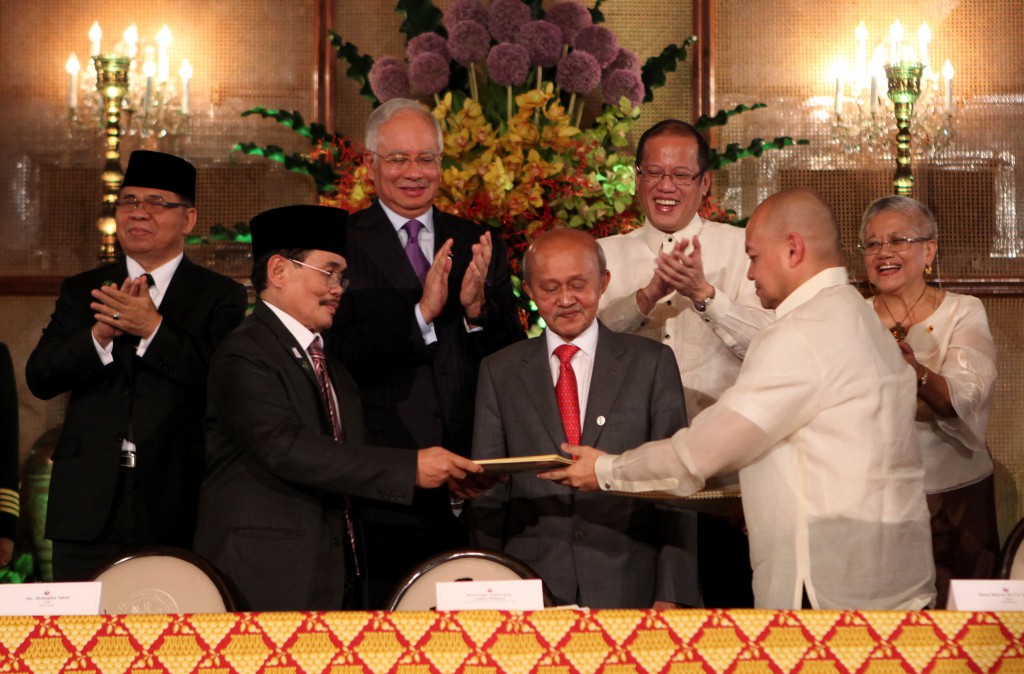
A FINAL peace deal between the Moro Islamic Liberation Front (MILF) and the Government of the Philippines (GPH) has moved one step closer to reality after the two parties signed the contentious wealth-sharing annex in Kuala Lumpur on July 14.
One of the four annexes needed to complete the peace agreement, the wealth-sharing annex was finally agreed upon after extensive delays. Its passage representing a significant success for the two negotiating parties, it will determine how the planned Bangsamoro political entity and the GPH will divide the revenue collected from the resource-rich region.
In a text to Rappler, MILF chief negotiator Monagher Iqbal said that the agreement was “a collective success. I am looking at the next challenges.”
Thus, two of the four annexes needed to sign the final peace deal have been approved. Earlier this year, the annex creating a Bangsamoro Transition Council was also signed.
As of now, only the annexes on power-sharing and normalization remain unsigned.
Fight for natural resources
The wealth-sharing annex proved to be one of the biggest hurdles in finalizing the comprehensive peace agreement. This and the power-sharing annex are considered the “heart of the pact.”
Julkipli Wadi, dean of the University of the Philippines Institute of Islamic Studies, pointed out that wealth-sharing has always been one of the key issues thwarting potential peace agreements with Mindanao. During the Arroyo administration, it was one of the main issues that caused the failure of the previous proposed peace agreement, the Memorandum of Agreement on Ancestral Domain.
Wadi acknowledged that the issue is indeed sensitive, since wealth-sharing involves the handling of “strategic resources.”
“If you’re the one handling the proceeds from resources [pertaining to the GPH], then all of a sudden you have someone sharing it with you and it turns out your old enemy (the MILF) is set to have a larger share than you, would you give it up easily? Obviously, it’s complicated,” Wadi explained in a mix of English and Filipino.
Fortunately, the concerned parties were able to reach a compromise.
Major points
According to a statement by the Office of the Presidential Adviser on the Peace Process, fees and charges collected from the Bangsamoro will be divided between the Bangsamoro and national governments.
75 percent of taxes, fees and charges collected from the Bangsamoro will go to the Bangsamoro government while 25 percent will be for the national government.
Likewise, in the case of income generated from exploration, development and utilization of metallic minerals, 75 percent will be for the Bangsamoro while the rest will go to the national government. All revenues collected from non-metallic resources, on the other hand, will go to the Bangsamoro and their local government units.
The Bangsamoro and the national government will equally share the income generated from fossil fuels and uranium.
In addition, the Bangsamoro is to “have authority and control over existing government-owned and controlled corporations and financial institutions operating exclusively in the Bangsamoro territory, after determination by the intergovernmental fiscal policy board of its feasibility.”
The Bangsamoro will also have control over revenues “of Bangsamoro government-owned and controlled corporations, financial institutions, economic zones and freeports operating therein.”
“Move forward or delay”
Initially, many had doubts about the government’s commitment to the peace process.
Political Science Deparment lecturer Arjan Aguirre, however, believes that the Aquino administration is “serious when it comes to peace talks.”
“The mere fact that the Aquino administration is focused on reform-oriented measures [means that they are] really doing something when it comes to reforming society. They really want to solve whatever problems there are and one of these problems is armed conflict.”
However, Mark Angeles, a writer for Kataga Manila and the Kilometer 64 Poetry Collective, begged to differ. “I think PNoy’s panel was only grandstanding when it announced that the framework agreement it started will pave the way for a final and enduring peace in Mindanao,” he argued.
According to Angeles, “Bangsamoro is a principle, the Muslim principle.” He added, “Unfortunately, most of the leaders in Mindanao do not carry that principle.”
Mindanaoan perspective
Xavier University College of Law student Earl Larroder, a Zamboanga native, stressed that Mindanaoans should be consulted since they are the ones directly affected.
Larroder said that it is “more important to ask people directly affected in the conflict, not just the opinions of presidential legal advisors or Manila-born members of the peace panel.”
Moreover, Larroder added that the MILF “must first settle their inner divisions” for the peace process to work. “The MILF must consolidate their leadership and discipline their ranks to earn the respect of the peace panel,” he said.
Last two hurdles
With the major breakthrough in negotiations, many are urging the two parties to take advantage of the momentum. It is not the time for the negotiating parties to rest on their laurels.
Wadi hopes that the two parties will hasten talks.
“Let us not prolong this process anymore. The three years that were spent for this peace process is already a long time,” he said in a mix of English and Filipino.
He further stressed the need to be “creative and flexible this time, given the fact that the Mindanao conflict has already been with us for 50, 60 years.”
In the meantime, the two parties are expected to resume discussions on the two remaining annexes sometime in early August, after the Muslim holy month of Ramadan.