Photo by Miguel R. Santiago
AIESEC ATENEO pinned the Philippines global recognition by ranking sixth in the Incoming Exchanges for Global Community Development Program (GCDP) for the first quarter of 2012.
It rose to one of the top among 2,100 university members and 700 local committees in more than 100 countries. AIESEC Ateneo followed committees in universities from Italy, India, Mauritius and Sri Lanka in the rankings.
AIESEC Ateneo had 44 foreign interns who participated in its different GCDP projects, namely Code Red, Project Gold, Legacy Project and Explore Philippines. A total of 201 outgoing and incoming exchanges were made for the previous term.
“Each [count in the list] is equal to a life changed,” said former Vice President (VP) For Incoming Exchanges Claire Fuerte.
The interns took part in different hands-on activities, such as planting crops in Marikina, making a sprinkler system from water bottles, teaching children how to read, and writing blog posts about their travels in the country.
Former AIESEC Ateneo President Kathleen Kho, under whose term the first quarter of 2012 fell, said that through these projects, the organization works for “peace and fulfillment of humankind’s potential.”
Founded in 1948, AIESEC is an international platform where the youth can explore and develop their potential through leadership development and global learning experiences. It was introduced in the Ateneo in 1969.
Projecting realities
According to Kho, the GCDP is naturally strong in the Philippines since it is a developing country—the best venue for a program that presents opportunities for projects responsive to social issues.
Member Committee Vice President (MCVP) for Projects Katrina Sanchez said that through exchanges, interns become aware of certain realities that the Philippines shares with other countries, especially the Southeast Asian nations.
Meanwhile, MCVP for Outgoing Exchange TJ Godiaco said that every wave of exchanges is always interesting because of the unpredictable mix of people. “It feels exciting whenever you see the dynamics of people working together from different countries to make positive impact,” he said in a mix of English and Filipino.
He also said that international AIESECers now consider the Philippines as a notable fast-emerging entity in the global AIESEC community. Kho further added, “If you look at the ranking of the countries [in the AIESEC network], [it is] very similar to global economies.”
Brazil, Russia, India and China, which have the fastest growing economies, are also the top four countries in the AIESEC network. Colombia, Indonesia, Vietnam, Egypt, Turkey and South Africa, which are some of the world’s emergent powerhouses, also belong to the Top 20.
More impact
Being ranked sixth internationally was a good indication for the organization in terms of aligning AIESEC Ateneo to the national and global communities. “Now we want to be more relevant—we want to have more impact,” Sanchez said.
Godiaco said that the ranking serves as a quantifier for them to gauge their progress.
“We are at a level where other countries or entities can get our good case practices. The Philippines could be a model to all other AIESEC entities all over the world,” he said.
According to Kho, projects in the organization are grounded on social relevance and are mainly focused on the United Nations Millennium Development Goals.
This June, AIESEC is planning to engage in a sustainable energy project with the Aboitiz Group, a local company.
Prime movers
Despite the world recognition, AIESEC Ateneo is not completely satisfied. “We’re not totally celebrating,” said Sanchez. “What’s the point in growing so much as a local committee if your country is not growing with you?”
In the national network, Godiaco acknowledges the ranking as an opportunity for AIESEC Ateneo to become motivators to local committees and help them with their operations. The reason for this is that other universities and local committees are not faring as well as the Ateneo and the University of the Philippines.
Sanchez echoed Godiaco’s sentiments. “[Being in Top 10 does not just mean that] you want to be associated with the successful organization. In terms of local committees, you also want to work with [the local organizations] who have good case practices to share,” she said.
According to Fuerte, the previous term’s expansion committee has reached out to help AIESEC in Cebu and Davao. The two are local committee extensions of AIESEC Ateneo.
AIESEC Ateneo has also conducted trainings and shared materials with other committees, such as Enderun, through the National Trainers Guild initiative.
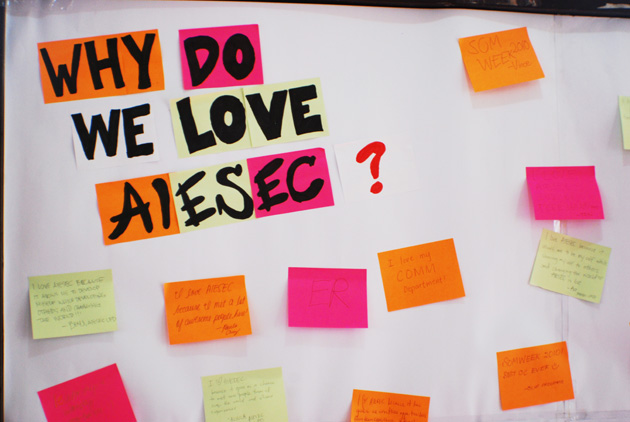
Photo courtesy of AIESEC ADMU.