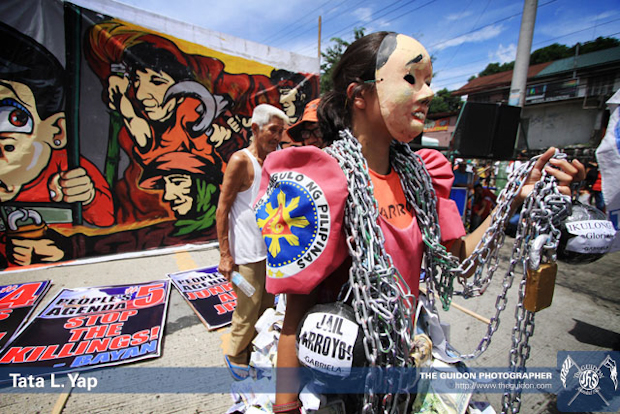
On November 16, 2004, around 6,000 plantation workers—including their families and children—picketed in Hacienda Luisita, in a brave effort to push for fairer wages, just treatment, and land reform. The Cojuangco landlords, however, were quick to take offense in these peasants’ actions.
By the end of the day—in a move later defended by then Rep. Noynoy Aquino in Congress—at least seven picketers were killed in a violent dispersal by the military and the police. The Cojuangcos, it seemed, found it hard to give up their grip on an estate their patriarch had acquired more than 50 years ago, even though there was an agreement that the land would be distributed to the peasants after ten years. For years, the Cojuangcos have devised plots—such as the discredited Stock Distribution Option—to maintain their hold on an estate larger than the cities of Pasig and Makati combined.
The issue of Hacienda Luisita has come to symbolize the country’s crippling semi-feudal situation. Luisita, however, is merely the tip of the iceberg; farmers suffer similar plights in a lot of other haciendas. The prevalence of this injustice owes to the fact that while 75% of the populace are agricultural workers, as much as 60% of the country’s agricultural lands are in the hands of just a few landlord families.
President Noynoy Aquino has been silent on the issue ever since his inauguration. Particularly for Luisita, he says he will pursue a “hands-off” policy.
In the Ateneo, there is a similar, deafening silence.
Fight for Sumilao
Right now, there is little to remind the community that less than three years ago, the fight of the Sumilao farmers made rounds in the school’s classrooms, hallways, and conference halls. It was towards the end of 2007 that the school joined this fight, the eventual successes of which—due in part to the help of organizations such as the Pambansang Kilusan ng mga Samahang Pangmagsasaka (Pakisama)—have resulted into an improved standard of living for the farmers.
“The [Sumilao farmers] now harvest corn,” Pakisama National Coordinator and Development Studies lecturer Soc Banzuela says. “Do you know what that means to them? They can now eat on a regular basis.”
Banzuela recalls that his former students brought the fight of the farmers to the Ateneo. It started when, back in the first semester of SY 2007-2008, Banzuela and his Development Studies class discussed the situation of the farmers as a case study. By the end of the semester, five of his students decided to help the farmers.
Through the efforts of these students, the battle eventually gained steam in campus, especially when the Office for Social Concern and Involvement and Simbahang Lingkod ng Bayan supported the effort. The campaign succeeded in getting the farmers most of the 144-hectare property they were fighting for.
‘Tingnan nilang lahat’
However jubilant the community was about helping the Sumilao—and later on, the Calatagan and Banasi—farmers, the fact that Ateneo focused its agrarian justice efforts only on certain farmer groups irks some members of the community.
“In my view, Ateneo is selective about what issues to engage and which people to support,” Maki Lim (AB Lit Fil ‘09), former Matanglawin Editor-in-Chief, declared in Filipino in his column for the February 2008 issue of the publication.
“Are [the Sumilao farmers] the only peasants in the country suffering from injustice?” he asked. “When news about [the Hacienda Luisita massacre] broke, did the community respond?”
Lim, writing on the heels of the Sumilao campaign, stressed a point: the community has failed to engage itself in agrarian justice issues beyond that of the Sumilao, Banasi, and the Calatagan farmers.
Ka Florencio, a farmer from Hacienda Yulo, resents this.
“Ay hindi naman siguro maganda ‘yun—kung [ang mga Atenista] ay may pipiliing tulungan. (Well, that’s not bound to be nice—if Ateneans select who to help,” he says, lambasting the situation. “Sana sa pagtingin ng mga Atenista sa isa, ay tingnan nilang lahat! (Hopefully, when Ateneans examine something, they look at everything!)”
“In our place in Hacienda Yulo, in Buntog, the deployment of police and armed troops continues… They really sow fear among the villagers,” he laments in Filipino. “How can you not fear them? They suddenly enter your yard and look into your windows.”
Ka Francing, a farmer from Hacienda Luisita and a member of the United Luisita Workers’ Union, shares similar stories about the peasantry’s plight in the Cojuangco estate.
“A lot have already sacrificed their lives,” he says in the vernarcular, explaining that even the original dwellers of the estate, who have been living in Luisita long before the Cojuangcos came, are still fighting for the land.
Ka Francing wishes the Ateneo community could lend them a hand in their struggles.
“I hope Ateneans give attention to our plight,” he says. “The killings, the hunger—our country’s situation—can only find resolution in actions and movements aimed at helping others.”
Different strategy
Banzuela attributes the community’s lack of universal engagement on the issue of land reform to different reasons. For one, he mentions ‘connections’—that the Sumilao farmers were already affiliated to the Ateneo even before the noise of recent years.
Cheenee Otarra (AB DS ‘09), one of the five students mentioned earlier, agrees with her former professor.
“When we got to help the Sumilao farmers, it was because of our teacher,” she says. “If we are not able to help other groups, it’s probably because we do not know how to help them or who to contact in order to help them.”
Banzuela mentions that ideology is also a concern.
“Other groups have their own support institutions…They may come from the national democratic tradition,” he says. “Of course, there may be questions of ideological differences.”
‘Selective form of service’
Terry Ridon (HS ‘02), former Ateneo High School Sanggunian Chairman and current National Chairperson of the League of Filipino Students, agrees that national democratic groups are less likely to find support in the Ateneo.
“I think Ateneans—especially the Jesuits and educators inside Ateneo—are particularly allergic to certain political groups… which the Luisita and the Yulo farmers are part of,” he says. “They are allergic—ever since the world began—to the national democrats.”
Ridon blasts this kind of selectivity and labels it as counter to academic freedom. “It is clearly a selective form of service,” he says. “Just because one or two groups are [adherents] of a different ideology doesn’t make their struggle less important compared to the ones you support. I think the Ateneo needs to be accountable for that.”
This view is echoed by Lim in the Matanglawin column mentioned earlier.
“[Ateneo] is hesitant with getting involved if there is danger, and if there is a risk that the institution’s name would be besmirched—especially if the advocacies in question are the ones fought for by the radical elements of society,” the column argued. “Help is tainted by politics; one group is preferred over another.”
In the end, Banzuela and Otarra both agree that the Ateneo’s efforts to help peasant groups must not stop with the fights of the Sumilao, Calatagan, and Banasi farmers.
“There are so many groups that need support,” Banzuela says. “[Help] should be open to all farmers.”
For Otarra, such efforts must extend even beyond agrarian justice. She believes a lot of other sectors need help from the community.
Silence
The issue of land reform continues to be a major one for the country. Blood had been spilt, life has been taken, and land has been grabbed, all due to some families’ insistence on a feudal way of doing things. This issue also remains a major sticking point between social justice advocates and the Aquino administration. It is, after all, a matter of life and death.
“Land is gold to us farmers,” Ka Francing, the Luisita farmer, says. “A farmer needs land to live properly.”
It is with this strong sense of justice that peasants such as Ka Florencio and Ka Francing call on Ateneans to not pass them over in the fight for a better world, as is so often the case for the people at the margins.
“All of us Filipinos—we don’t like conflict. What we want is peace,” Ka Francing says. “But we all must act and have a say on what’s happening to our society.”
In this fight for their lives, Ka Francing, Ka Florencio, and millions of other peasants are waiting for Ateneo to break its silence.